On April 3, Lianhong New Materials Technology Co., LTD. (hereinafter referred to as "Lianhong Xinke") issued A prospectus for the issuance of A-shares to specific objects (declaration draft). The announcement said that no more than 267,113,600 shares (including the number) were issued to specific objects, and the total amount of funds raised was expected to be no more than 2.02 billion yuan (including the number), and the net amount of funds raised after deducting the issuance cost was intended to be invested in the integration project of new energy materials and biodegradable materials.
It is reported that the total investment of the project is 12.5 billion yuan, which is newly built by Lianhong Gerun, a subsidiary of Lianhong Xinke Holding. The construction site is located in Lunan high-tech Chemical Park, Tengzhou City, Shandong Province. The construction includes 1.3 million tons/year methanol to olkene (DMTO) plant, 200,000 tons/year ethylene-vinyl acetate copolymer (EVA) plant, 300,000 tons/year propylene oxide (PO) plant, 50,000 tons/year polypropylidene carbonate (PPC) plant, supporting public works and auxiliary production facilities.
In recent years, the issue of climate warming caused by CO2 emissions has become the focus of global governance. In order to cope with climate change, countries around the world have issued corresponding laws and policies, and many industries are actively seeking solutions. For the chemical industry with high energy consumption and high emissions, the capture and utilization of CO2 is very important. At present, PPC is one of the most deeply studied and most industrialized CO2-based copolymers, and its emergence is expected to provide a new means for the decarbonization of chemical industry.
 PPC is a kind of carbonate polymer, which is a completely degradable environmentally friendly plastic synthesized by open ring alternating copolymerization with PO when CO2 is activated to a high degree under the action of catalyst (bimetallic coordination PBM type, etc.).

PPC is an amorphous material. Its application range is limited by its high molecular flexibility, poor mechanical properties and easy adhesion and deformation at high temperature. However, compared with other biodegradable materials, PPC has the advantages of good toughness and balance, good barrier property, high transparency, excellent water retention, biodegradable and so on, is an ideal disposable film material, can replace traditional non-degradable materials, the future market potential is huge, especially in the replacement of traditional plastic film materials with greater market development potential.
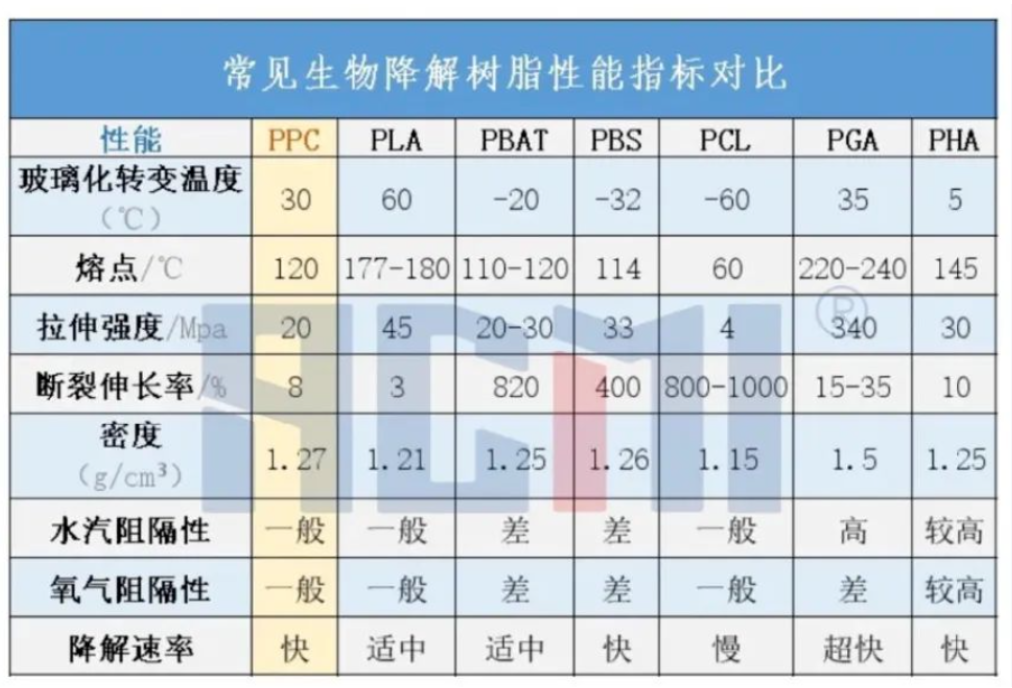
Due to the low glass transition temperature of PPC, plastic products used at low temperatures can be prepared, such as frozen meat cling film bags; And good transparency, melt strength, sealing strength, so that it is widely used in film products, such as disposable medical, food packaging materials. It can also be blended with other types of plastics (such as PP, PE, PC, etc.) to improve the solvent resistance and oxygen insulation of the product.
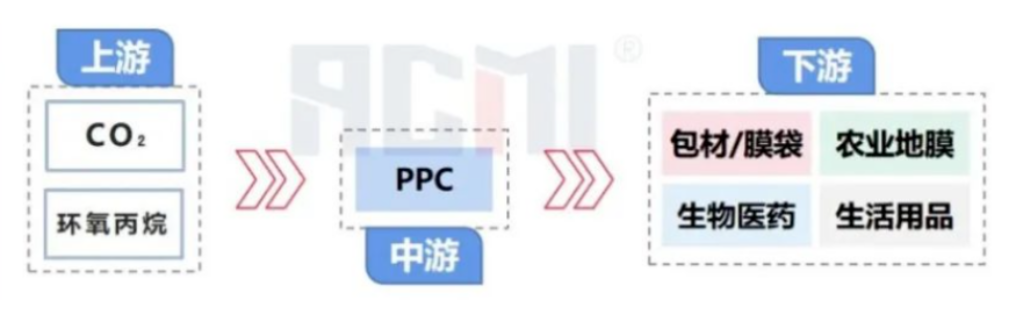
The upstream chemical raw materials involved in PPC are mainly PO. In addition to the preparation of PPC, PO is also an important basic chemical raw material, mainly used in the production of polyether polyols, propylene glycol and various non-ionic surfactants.
Since PPC was first produced by Japanese scientist Inoue in 1969, it has quickly attracted attention, opening up a new field of using CO2 as a raw material to synthesize biodegradable polymers.
A large number of CO2 and epoxide copolymerization studies were conducted in the United States in the 1970s and 1980s, but after the 1990s, European and American manufacturers such as Empower, Materials.Inc., Caffaro, etc. stopped the research successively, except for a few universities.
PPC research in China started relatively late compared with European and American countries, but it has been developed for more than 20 years. At present, China is the world's main PPC producer and demand country. In 2019, the output of China's PPC industry was 19,400 tons, and the demand was about 18,500 tons; In 2023, the output of China's PPC industry increased to about 39,800 tons, and the demand increased to about 38,300 tons.
At present, the main research units of PPC in China are the Chinese Academy of Sciences, Sun Yat-sen University, Lanhua Institute, etc., and the main enterprises are Nanyang Zhongjutianguan Low-carbon Technology Co., LTD., Jiangsu Zhongke Jinlong Chemical Co., LTD., Inner Mongolia Mengxi High-tech Group Co., LTD.

At present, the main reasons restricting the development of biodegradable materials industry are: high cost, technical barriers, low economic benefits. However, for PPC, its development is mainly limited by the complex process in the synthesis process, low catalytic efficiency, difficult to control side reactions and other technical bottlenecks. At present, there are few 10,000-ton PPC industrialization devices in stable operation worldwide, and the domestic Huafeng Group has the news that the PPC project has been put into operation - "On November 16, 2022, Zhejiang Huafeng Environmental Protection Materials Co., LTD. 's annual production of 10,000-ton PPC project has completed the equipment installation, commissioning and driving work, and has produced products satisfactory to users." The subsequent planned expansion capacity will reach 300,000 tons/year.
Secondly, the main way to solve the new "white pollution" in addition to the use of biodegradable plastics, can also use recyclable technology to produce plastic products containing recyclable materials, and this will greatly limit the development of biodegradable plastics. At present, policy shifts in certain regions have also triggered industry companies, especially international chemical giants (such as LyondellBasell, SABIC, Solvay, etc.), to begin to actively deploy recyclable/recycling industries.
Biodegradable plastics industry is developing rapidly around the world, and China has become the world's largest producer of biodegradable plastics. According to Longzhong Information statistics, the global degradable plastic production capacity in 2022 is about 1.7 million tons, of which domestic production capacity is 1.28 million tons, accounting for 75% of the world's production capacity. As a biodegradable material with excellent performance, PPC has great market potential, especially in the field of replacing traditional plastic film materials. It is expected that by 2025, the domestic consumption of degradable plastics will reach 2.5 million tons, and the future development space is very broad.
 PPC is a kind of carbonate polymer, which is a completely degradable environmentally friendly plastic synthesized by open ring alternating copolymerization with PO when CO2 is activated to a high degree under the action of catalyst (bimetallic coordination PBM type, etc.).

