Recently, the National Development and Reform Commission (NDRC) and the National Energy Administration (NEA) have issued the Implementation Opinions on Promoting the High-Quality Development of "AI +" Energy (hereinafter referred to as the Implementation Opinions).
The Implementation Opinions puts forward phased goals for the development of artificial intelligence (AI) in the energy sector:
-
By 2027, efforts will focus on laying a solid foundation, setting up good benchmarks, and improving the system. Aiming at addressing issues such as uneven intelligentization levels in the energy sector, insufficient support from generic technologies, and the lack of large-scale application, priority will be given to advancing the "Five-Ten-Hundred" Project. Specifically, this involves promoting in-depth application of over five professional large models in industries including power grids, power generation, coal, and oil & gas; identifying more than ten key demonstration projects that are replicable, promotable, and competitive; exploring empowerment pathways for 100 typical application scenarios; formulating and improving 100 technical standards; fostering a number of industry-level R&D and innovation platforms; and establishing an AI technology innovation and development model in the energy sector that is in line with China's national conditions.
-
By 2030, with a focus on achieving independent controllability, in-depth empowerment, and international leadership, and based on previous technological accumulation and scenario verification, efforts will be made to drive systematic breakthroughs and large-scale implementation of AI-specific technologies in the energy sector.
Centering on various energy types such as coal, electricity, oil, and gas, the Implementation Opinions makes systematic arrangements for eight "AI +" application scenarios in the energy field, including power grids, new energy formats, new energy, hydropower, thermal power, nuclear power, coal, and oil & gas, so as to enable the energy sector to share the dividends of AI development. Vertically, it will strengthen AI's role in improving quality and efficiency of energy production, supply, storage, and marketing across links such as energy equipment manufacturing, energy production, transmission, dispatching, and consumption, thereby enhancing the overall efficiency of the energy system.
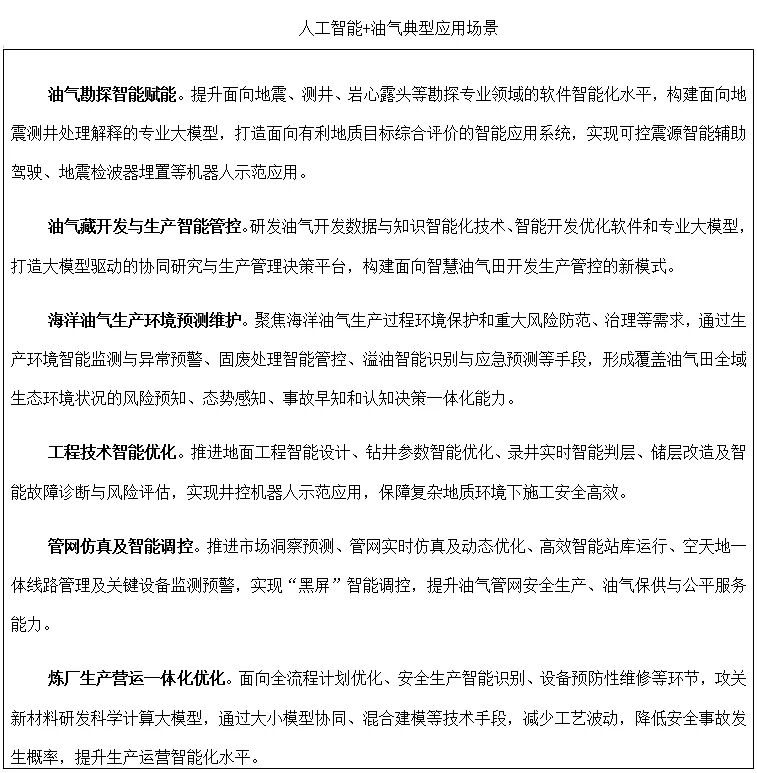
The Implementation Opinions specifies 37 key tasks for the integrated application and development of "AI +" energy, covering over 100 scenarios. Among these tasks, 6 are in the oil & gas field; 5 each in coal, power grids, hydropower, and new energy formats; 4 each in thermal power and new energy; and 3 in nuclear power. Meanwhile, it outlines the development paths and goals for each task.
For example, in promoting the intelligent optimization of renewable energy-based hydrogen production processes, multi-dimensional data—such as wind and solar power fluctuation forecasts, hydrogen storage tank capacity, electrolyzer temperature, and catalyst status—will be integrated. Based on AI algorithms, the dynamic optimization of electrolyzer current density will be intelligently driven, and an intelligent control system covering the entire chain of electrolytic hydrogen production, storage, and utilization will be built. This will enable millisecond-level matching between renewable energy power fluctuations and the flexible load of electrolytic devices.
In the "AI + oil & gas" field, focus will be placed on cross-disciplinary collaborative research, on-site operation control, and production operation management. Efforts will be made to advance intelligent evaluation of exploration geological targets, intelligent optimization of development plans, intelligent adjustment of operational parameters for drilling and fracturing, intelligent operation of refining and chemical equipment, and real-time simulation of pipeline network operation. Additionally, the R&D and application of intelligent production technology and equipment—such as intelligent drilling rigs, robots, drones, and intelligent perception systems—will be accelerated to drive full-process intelligent linkage and automatic optimization in production sites and other links, and promote the intelligent upgrading of the oil & gas industry chain.
In addition, centering on data, computing power, and algorithms, the Implementation Opinions systematically builds a fundamental support system for AI applications, and proposes three key generic technology R&D directions for the application of AI in the energy sector:
- Consolidate the data foundation: Accelerate the development of high-quality datasets in the energy sector and ensure the whole-process security and reliability of energy data;
- Strengthen computing power support: Make overall plans for resources and establish a collaborative development mechanism for computing power and electricity that enables in-depth integration of the two;
- Enhance the basic capabilities of models: Promote in-depth integration of AI with software in the energy sector and accelerate breakthroughs in technical bottlenecks related to green and low-carbon AI technologies.
Going forward, the National Energy Administration (NEA) will comprehensively consider factors such as the application potential, maturity, and driving role of industries including coal, power, oil, and gas. It will select a batch of high-value scenarios for AI application in the energy sector, and encourage various innovation entities such as enterprises, research institutes, and universities to build high-level R&D and innovation platforms as well as innovation alliances. Efforts will be made to explore the construction of industry-level AI application testing platforms, which will effectively synergize with large models independently developed by enterprises. This aims to address the issue of "re-inventing the wheel" in large model development and avoid excessive consumption of advanced computing power and energy resources. Moreover, a batch of replicable and promotable benchmark scenarios and cases will be selected, and innovations in institutional mechanisms and business models will be encouraged to advance the implementation of AI-related scientific and technological projects in the energy sector and the transformation of their achievements.

