Have you ever been troubled by bubbles and dust when applying a screen protector to your phone? Now, imagine if the object to be adhered to is a beating heart, a brain full of folds, or a nerve as thin as a hair—these challenges would multiply exponentially. This time, Chinese scientists drew inspiration from the millennia-old printing technology and offered an elegant solution: using a single drop of water to achieve a "perfect adhesion" of electronic devices.
On September 11, a research team led by Researcher Song Yanlin from the Institute of Chemistry, Chinese Academy of Sciences, in collaboration with multiple research institutions including Beijing Tiantan Hospital of Capital Medical University and Nanyang Technological University in Singapore, published a groundbreaking technology—"Drop-printing"—in the journal Science. This technology has successfully solved the problem of ultra-thin flexible electronic devices being difficult to adhere to complex biological surfaces without damage, opening up a new technical path for fields such as brain-computer interfaces, nerve repair, and wearable medical devices.
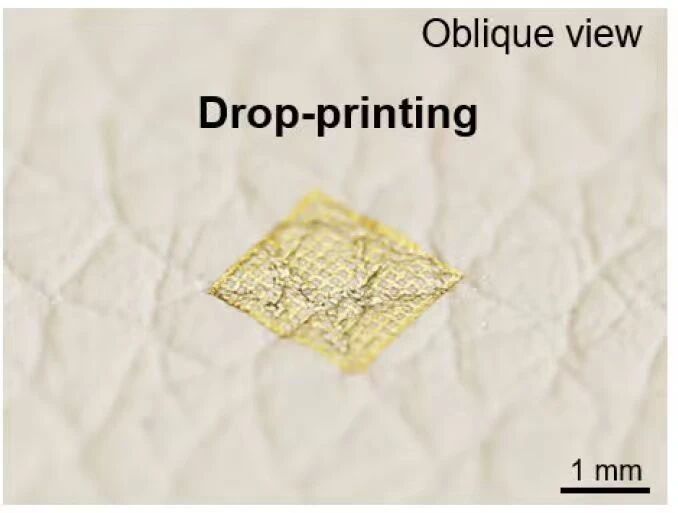
The core of the "Droplet Printing" technology lies in using droplets as a medium to construct a liquid lubricating layer between an ultra-thin film and the target surface. This liquid layer not only enables the film to naturally adhere to complex curved surfaces through capillary action but also allows the film to slide slightly and freely during the deformation process. In this way, it dynamically relieves stress and prevents breakage.
Simply put, it is similar to adding a layer of "water-based lubricant" when applying a film. Instead of being pressed onto the surface in a "hard-to-hard" manner, the film "floats" on the liquid surface and adheres adaptively—achieving both precision and no damage.
This technology is applicable to a variety of liquids. By adjusting the composition of the droplets (such as adding cell nutrient solutions or biological glues), it can also realize the transfer of cell films or underwater adhesion, greatly expanding its applicability in biological environments.
In experiments, the research team successfully attached a gold film with a thickness of only 150 nanometers completely to the surface of micron-scale paramecia, dandelion fluff, and even the complex textures of seashells—scenarios that are almost "impossible tasks" for traditional transfer technologies.
What is even more surprising is the in-vivo experiment: researchers "attached" an ultra-thin silicon-based electronic film to the sciatic nerve and cerebral cortex of mice using the droplet printing technology. Subsequently, through optical stimulation, they successfully triggered the regular movement of the mice's legs and simultaneously collected clear neural electrical signals.
This means that they not only achieved the adhesion of the device but also constructed a stable, undamaged neural-electronic interface that can work accurately. All of this was accomplished without the use of external pressure, adhesives, or causing any visible damage to the tissues.
Song Yanlin stated that in the current development of flexible electronic technology, "how to adhere well" is almost as crucial as "how to make well". Ultra-thin devices are extremely prone to damage due to stress concentration during the adhesion process, which has become one of the bottlenecks restricting their application. The "Droplet Printing" technology proposes and verifies a method of "achieving stress relief through liquid-phase interface regulation" from the principle level. It is not only applicable to the currently popular brain-computer interfaces and neural regulation devices but can also be extended to fields such as wearable devices, intelligent sensing, tissue engineering, and even micro-nano manufacturing.
As Song Yanlin put it: "With the advancement of science and technology, printing technology, which promotes the development of civilization, will continue to radiate new vitality." The emergence of droplet printing technology has opened a new door for the integration of flexible electronics.


