Ethylene glycol, also known as ethylene glycol, referred to as MEG, is the simplest diol, the appearance of colorless viscous liquid, can be miscible with water, acetone, mainly used for the production of polyester fiber, antifreeze.
The ethylene glycol process is mainly divided into ethylene glycol and syngas ethylene glycol. According to the different ethylene sources, the ethylene process can be divided into naphtha cracking to ethylene, ethane cracking to ethylene (petroleum associated gas, shale gas) and MTO ethylene, ethylene oxidation to ethylene oxide, and finally ethylene oxide to ethylene glycol. Coal is used as raw material to produce ethylene glycol from syngas. Carbon monoxide and hydrogen are obtained by gasification, conversion, purification and separation. Carbon monoxide is then coupled and esterified to produce oxalate, which is then hydrogenated with hydrogen, and polyester ethylene glycol is obtained by refining.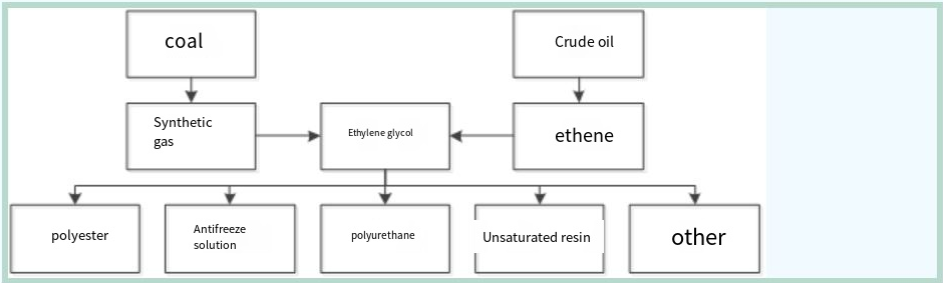
Ethylene glycol is large, and its downstream is also abundant. Ethylene glycol downstream mainly polyester, antifreeze, polyurethane, unsaturated resin and other industries, of which polyester is the largest downstream ethylene glycol products. The production capacity of the polyester industry has reached 67.51 million tons, the operating rate of the industry is near 80%, and the demand of the polyester industry accounts for 93% of the total demand.
Polyester is made of ethylene glycol and refined terephthalic acid condensation, polyester can be subdivided into polyester bottle sheet, polyester fiber and polyester chip, mainly used in beverage bottle packaging, polyester spinning, film packaging and other terminal industries. Among them, polyester fiber is the largest downstream polyester industry, is a kind of synthetic fiber, referred to as polyester, can be further processed into polyester staple fiber, polyester filament and polyester industrial silk, polyester because of its superior high elasticity, heat resistance and plasticity, widely used in terminal textile products.
Downstream industries such as antifreeze, polyurethane, and unsaturated resins, although they account for a relatively small proportion in the downstream ethylene glycol, they occupy an equally important position in the ethylene glycol industry chain because of their stable ethylene glycol consumption.


