
New energy heavy-duty trucks are undoubtedly one of the most noteworthy tracks in the power battery industry in recent years.
As electric heavy-duty trucks are rising at an astonishing speed, the sales volume of heavy-duty truck power batteries, the core engine behind them, has also soared simultaneously.
In 2024, domestic sales of new energy heavy-duty trucks reached 82,700 units, a year-on-year increase of 139.4%. Meanwhile, the installed capacity of power batteries for charging-only models of China's electric heavy-duty trucks in 2024 alone reached 26.8 GWh, a year-on-year increase of 120.5%.
This growth rate is much higher than the 37.3% growth rate of the overall power battery installed capacity of new energy vehicles in the Chinese market during the same period.
In the first half of this year, this trend was further confirmed: in June 2025, domestic sales of new energy heavy-duty trucks reached 14,800 units, a year-on-year increase of as high as 187%.
Since new energy heavy-duty trucks often use 314 battery cells, which are the same specification as those used in energy storage systems, some people even joke that trucks have started to compete with energy storage systems for production lines.
Looking back at the development of new energy heavy-duty trucks, it turns out that it is not simply a matter of transplanting and applying electric passenger vehicle technologies. Behind it is the continuous iteration of heavy-duty truck battery solutions, which have finally crossed the inflection point.
Due to their huge self-weight and load, high drag coefficient, heavy-duty trucks consume far more energy per mile traveled than passenger vehicles, making them veritable "energy hogs".
The scenarios in which they are used are also vastly different from those of passenger vehicles, with loads often reaching dozens of tons, high-intensity operations covering hundreds of kilometers per day, and stability requirements under extreme working conditions.
The demand for durability and resistance to wear has posed severe challenges to battery technology, and it is precisely the continuous breakthroughs in battery technology that have transformed electric heavy-duty trucks from a concept into a practical reality.
Breakthrough in driving range
The leap in battery energy density is the core support for the practical application of electric heavy-duty trucks. Energy density is a key indicator of the "electricity storage capacity" of electric heavy-duty trucks, which can directly increase the driving range.
Traditional fuel-powered heavy-duty trucks can travel 800-1000 kilometers on a single refueling, covering core scenarios such as intercity trunk lines and long-distance logistics; however, early electric heavy-duty trucks, with a range of less than 200 kilometers, were limited to closed or short-distance scenarios such as ports and mining areas.
Today, the energy density of large-capacity battery cells used in heavy-duty trucks has exceeded 220Wh/kg, supporting a driving range of up to 800 kilometers. This has completely broken the scenario limitations, enabling electric heavy-duty trucks to undertake medium and long-distance transportation tasks.
At the same time, the improvement in energy density has indirectly increased the effective cargo-carrying weight by optimizing the battery's volume-to-weight ratio, further enhancing its practical operational value.
After solving the problems of range and load capacity, energy replenishment efficiency has become a key bottleneck restricting operational efficiency. Compared with the 10-minute refueling time of traditional fuel vehicles, electric heavy-duty trucks once significantly affected the operation rhythm due to slow charging.
To address this pain point, the industry has formed two schools of thought with parallel "ultra-fast charging" and "battery swapping" paths:
Ultra-fast charging school: Achieving rapid energy replenishment through high-power charging equipment.
In the past, a 350kW charging pile took 1-2 hours to fully charge a 300kWh battery, but currently, the maximum power of ultra-fast charging piles has reached 1.5 megawatts, which can supplement about 20 kWh of electricity per minute. Charging a battery of the same capacity now only takes 15 minutes.
This means that vehicles can make 1-2 more trips per day, significantly improving logistics efficiency and economy, and is suitable for long-range continuous operation scenarios such as highway routes. Huawei is the leader of this school.
Battery swapping school: It relies on standardized battery boxes to achieve rapid replacement.
A single battery swap takes only 5 minutes, with efficiency close to that of refueling. This mode is more suitable for high-frequency operation scenarios with fixed routes such as ports, mines, and short-distance transshipment, greatly reducing the waiting cost for energy replenishment.
This school of thought is strongly promoted by CATL.
A sudden surge in cost performance
All industries are engaged in price competition, and electric heavy-duty trucks are naturally no exception. After battery-grade lithium carbonate reached a peak of nearly 600,000 yuan per ton in November 2022, it dropped sharply, and this trend eventually spread to the power battery sector.
The price of power battery cells has been falling continuously since 2023 and has now dropped below 0.4 yuan per watt-hour, directly driving down the cost of the entire vehicle.
For example, the market price of a heavy-duty truck equipped with a 423kWh battery has dropped from 630,000 yuan in 2023 to around 500,000 yuan now, approaching the price of fuel-powered heavy-duty trucks.
In addition, the cost of electricity is significantly lower than that of diesel. Calculated at the industrial electricity price of 0.7 yuan per kWh, the electricity cost per kilometer is less than 0.25 yuan, which is much lower than the fuel cost of about 2 yuan per kilometer for diesel trucks.
At the same time, electric heavy-duty trucks eliminate complex assemblies such as engines and gearboxes, resulting in lower maintenance costs. With the superposition of multiple cost advantages, it is conservatively estimated that the total cost of ownership (TCO) of electric heavy-duty trucks is more than 100,000 yuan lower than that of fuel-powered heavy-duty trucks, which also makes electric heavy-duty trucks attractive as commodities.
The battery arms race among giants
As core component suppliers for electric heavy-duty trucks, major battery manufacturers will naturally not miss out on this big opportunity. They have successively launched new battery products and solutions tailored for heavy-duty truck applications, striving to gain a foothold in this market.
CATL: Focusing on standardization + battery swapping
The No. 75 standard battery swap block released by CATL in 2025 is the result of its exploration into the standardization of heavy-duty truck batteries. CATL has developed a chassis battery swap interface, which, figuratively speaking, equips heavy-duty trucks with "Lego brick"-style battery interfaces. This enables compatibility and universality among models from different manufacturers, and also facilitates mass production of batteries to reduce costs.
In addition, CATL is actively laying out a battery swapping network, proposing to build a national "eight horizontal and ten vertical" trunk line battery swapping corridor by 2030.
It will build 1,000 heavy-duty truck battery swapping stations by the end of 2025 on its own, and jointly build more stations with partners, forming a complete ecosystem covering battery supply, battery swapping station operation, and battery recycling.
EVE Energy: Customization for segmented scenarios
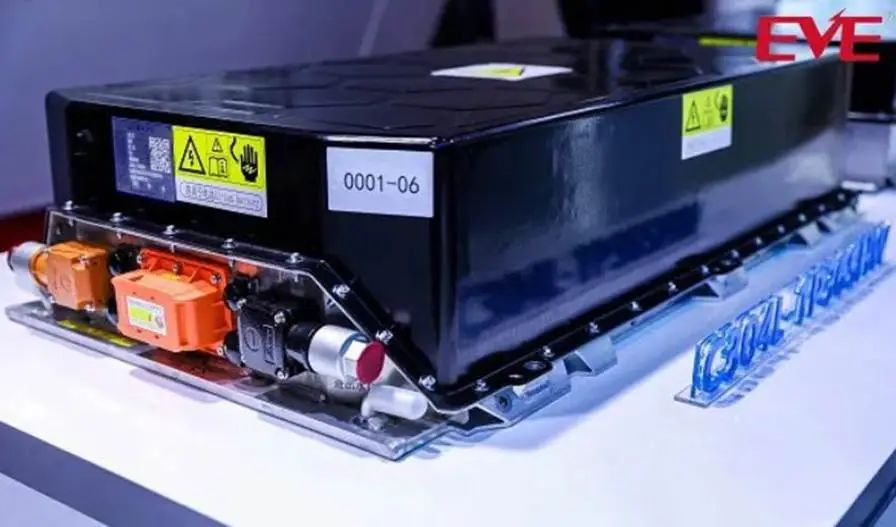
In 2025, EVE Energy released the third-generation commercial vehicle "Kaiyuan Battery" product matrix, which means "opening up sources and reducing expenditures". Covering full-scenario applications such as microvans, light trucks, heavy trucks, buses, and construction machinery, it launched 4 heavy-duty truck batteries of different specifications at one time, optimized respectively for segmented scenarios such as short-haul transportation and trunk line logistics.
BYD: Blade Battery + Multi-gun Fast Charging
All heavy-duty truck series launched by BYD are equipped with the company's self-developed lithium iron phosphate blade batteries, supplemented by multi-gun ultra-fast charging technology.
Blade batteries are known for high safety and long service life. Meanwhile, they adopt a CTP (Cell to Pack) module-free structural design, which can increase the space utilization rate from about 40% of traditional batteries to 60%. This allows more battery cells to be arranged in the same volume of space, thereby improving energy density.
In terms of charging, BYD heavy-duty trucks innovatively adopt a four-gun simultaneous charging design, which can support a maximum current of 1000A and a power of 600kW, enabling a full charge within 40 minutes in the 20%-80% state of charge range.
Gotion High-Tech: Lightweight, Long-Lasting + All-Climate Adaptability
In 2025, Gotion released the new "G Xing" heavy-duty truck battery, which provides solutions to the three major pain points of heavy-duty truck users: short battery life, slow charging, and incompatibility with extreme temperatures. It can still charge efficiently in -30℃ environments and achieve precise control of battery temperature from -40℃ to 65℃.
In addition, the "G Xing" battery also pursues ultra-long service life and zero attenuation, with a total service life of 12 years and 10,000 cycles, and a cumulative driving distance of more than 4 million kilometers. Its lighter weight and slower attenuation allow users to carry about 0.5 tons more cargo per trip, greatly enhancing operational value.
However, for the time being, CATL still holds a commanding lead in the heavy-duty truck market, and this advantage is even greater than its position in the power battery sector as a whole.
Each forms an alliance
In the process of electrification of heavy-duty trucks, a cooperation pattern between mainstream heavy-duty truck manufacturers and battery suppliers has gradually taken shape.
Most vehicle manufacturers adopt a multi-supplier strategy, widely introducing products from multiple battery companies. For example, in addition to CATL, the industry leader, Sany Group has also cooperated with many battery manufacturers such as EVE Energy, Rupo Lanjun, Gotion High-Tech, Yuanhang Jinli, CALB, and Chunergy, accumulating 6-8 battery suppliers in total.
This multi-supplier layout not only ensures the stability of battery supply and avoids excessive dependence on a single manufacturer, but also integrates the technical strengths of various companies, introduces different types of battery solutions, and helps gain greater initiative in the supply chain, forcing battery companies to optimize their products and prices.
However, some vehicle manufacturers choose to deeply bind with a small number of battery partners. A typical example is Hualing Motors, whose power batteries for new energy heavy-duty trucks are mainly supplied by Gotion High-Tech and EVE Energy. Through centralized procurement, Hualing may establish closer collaboration with suppliers, ensuring aspects such as customized battery development and supply chain.
Conclusion
Once, heavy-duty trucks were considered almost impossible to become mainstream due to their limited range and load capacity, but now they have emerged as a dark horse, becoming the segment with the fastest-growing demand for lithium batteries.
The breakthrough of electric heavy-duty trucks is undoubtedly another incremental market brought about by advancements in battery technology. This also implies a conclusion:
Everything that requires power can be powered by lithium batteries, and this can become a reality with the progress of battery technology.


