
Lithium battery production process and core equipment!

1. Material preparation
There are three main anode and cathode materials for lithium batteries: lithium lithium cobalt acid (LiCoO2), lithium iron phosphate (LiFePO4) and ternary materials (such as lithium nickelmangancobalt acid, LiNiMnCoO2). Lithium cobalt acid lithium battery performance is the best, but the price is also the most expensive, ternary material battery cost-effective. The material preparation process includes raw material treatment, mixing, preparation into paste and other steps. Among them, the preparation of electrolyte is also an important link, the main components are dimethyl carbonate, ethylene glycol and tributyl fluoride phosphate, etc.
2. Battery assembly
Battery assembly is made by stacking anode and cathode materials, electrolyte and diaphragm layer successively, and then fixed together by fasteners. To assemble, the anode and cathode materials are cut into appropriate shapes and then coated with a conductive agent to make the electrodes conductive. Diaphragm layer is mainly used to isolate positive and negative electrode materials to prevent short circuit. During the assembly process, it is necessary to ensure the pressure of anode and cathode materials and the uniformity of coating conductive agent, and also to control the injection amount and injection speed of electrolyte.
3. Test
After assembly, a series of tests are carried out to ensure battery performance and quality. One of the most important test items is the battery capacity and cycle life test. The battery capacity test can measure the amount of charge that the battery can store, while the cycle life test can simulate the life of the battery in the actual use process and detect the number of charge and discharge cycles of the battery under different charge states.
The core equipment involved in the manufacturing process of lithium battery includes:
Mixer: Used to mix positive and negative electrode materials and other additives evenly.
Spraying machine: Used for uniformly coating conductive agents on the surface of positive and negative electrode materials.
Press: Used to combine anode and cathode materials, diaphragm layer and electrolyte.
forework
The production and manufacturing process of lithium battery mainly includes the first step and the second step. The first step refers to the preparation of various parts of the battery, and the second step is to assemble these parts into a complete battery.
The first part of the process mainly includes slurry mixing, positive and negative electrode coating, roll pressing, slabbing, electrode production and die cutting.
In the stirring process, lithium battery vacuum mixer is used to mix the positive and negative active substance, solvent and binder to make the positive and negative substance without bubbles.
Coating is made of pulp evenly coated on the metal foil, and after drying, made into positive and negative electrode pieces.
Then comes the rolling process, the roller press through the upper and lower rollers opposite each other, the coated surface of the pole film for extrusion processing, so that the pole film from the original fluffy state into a dense state. This is apparently quite critical to energy density.
The slitting method is to cut the electrode belt rolled according to different battery models into the length and width required for battery assembly, and no burrs appear.
Electrode wafer fabrication is one of the core steps of battery preparation. Through mixing, pressing, rolling and other processes, positive and negative electrode materials are finally formed to meet the requirements of battery specifications.
Finally, die cutting, the battery diaphragm, positive and negative electrode pieces and other parts in accordance with certain specifications, in order to ensure the subsequent battery assembly work.
1. roll press
Roll press is a core device that compacts electrode materials, membranes and electrolytes in layers to form battery cells. In the manufacturing process of lithium battery, roll press is usually the last step of battery assembly.
The main working principle of the roller press is to superposition the electrode material and the diaphragm layer layer by layer through the action of the upper and lower rollers, and distribute the electrolyte evenly throughout the battery cell. A roller press usually consists of a fixed roll on the bottom and a moving roll on the top. The moving roll is driven by a motor to roll in the direction of the fixed roll, which compacts the electrode material and the diaphragm to form the battery cell.
The performance of the roll press has a crucial impact on the performance and stability of the battery, so the roll press needs to have the following characteristics:
Precision control: The roller press needs to accurately control the thickness, width and compression force of electrode material, diaphragm and electrolyte to ensure the consistency and stability of the battery cell.
Efficient production: The roller press needs to have efficient production capacity and can achieve high-speed continuous rolling.
High degree of automation: modern roller press is usually equipped with automatic control system, can realize automatic production process, reduce the difficulty of manual intervention and operation.
High reliability: the roller press needs to have a high degree of stability and reliability, can work continuously for a long time, and there will be no failure and shutdown problems.
In practical applications, the roller press usually makes different adjustments and Settings according to different battery models and requirements to meet the manufacturing needs of different battery cells. At the same time, the maintenance and maintenance of the roller press is also very important, the need for regular cleaning and lubrication, to ensure its long-term stable work efficiency and performance.
2. Slitter machine
Scutter is a special equipment used to cut the positive and negative electrode pieces of batteries or membrane materials into the required length and width according to certain specifications.
Under normal circumstances, the cutter used is a round knife or knife wheel, cutting precision is high, easy to operate. In the process of cutting, the tension and speed of the material need to be controlled to ensure that the cutting edge is smooth and does not produce defects such as burrs or cracks.
The structure of cutting machine usually includes cutting tool group, feeding device, tension control device, cutting adjustment device, winding device and other components. Among them, the cutting tool group is the core part of the cutting machine, cutting quality and efficiency are closely related to the quality and performance of the cutting tool.
In the production of lithium battery, the slitting machine is usually used to cut the electrode tape and diaphragm materials rolled into the required length and width according to the specified specifications for the subsequent battery assembly work. The cutting precision of the slitting machine is very important to the performance and stability of the battery, so the slitting machine usually plays an indispensable role in the lithium battery production line.
The middle part: the winding and liquid injection of the cell are completed
The winding and filling process of the battery cell is the middle process of the lithium battery production line, which mainly includes the following steps:
Cell winding: roll pressed positive and negative electrode pieces and diaphragm in a certain stacking sequence, through the winding machine for automatic winding operation. When winding is complete, a cylindrical cell assembly, the precursor of the cell, can be obtained.
Cell injection: The cell assembly is placed in a special injection machine, through which the electrolyte is automatically injected into the cell assembly. The amount and way of electrolyte injection have important influence on the performance and stability of the cell.
Sealing: Put the cell assembly completed with liquid injection into a special sealing machine, and seal the two ports of the cell to prevent electrolyte leakage through the heat sealing operation of the sealing machine.
The completion of these processes requires the use of a series of special equipment, including winding machine, injection machine, sealing machine, etc. The performance and precision of these devices directly affect the performance and stability of the cell. In lithium battery production lines, winding and filling processes are usually semi-automatic or fully automated to improve production efficiency and stability.
1. Winding machine
Cell winding machine is a key equipment in lithium battery production line, which is used to automatically wind positive and negative electrode sheets and diaphragms in a certain stacking sequence to generate cell components. Its main work flow is as follows:
Feeding: The cutting of positive and negative electrode pieces and diaphragm into the winding machine, usually through an automatic feeding mechanism.
Winding: According to the designed winding scheme and procedure, the winding machine will automatically wind the positive and negative electrode sheet and diaphragm to generate cell components. The winding machine is usually characterized by high speed, high precision and high reliability.
Blanking: After the winding is complete, the cell assembly is sent out of the winder through the automatic blanking mechanism to enter the next process.
Cell winding machine usually consists of the following parts:
Control system: used to control the running state of the winding machine and various parameters in the winding process, including winding speed, tension, stacking mode, cell diameter, pressure, etc.
Feeding system: Used to feed positive and negative electrode pieces and diaphragms into the winding machine, usually consisting of an automatic feeding mechanism.
Winding system: consists of electric core shaft, core shaft drive device, core shaft support device, winding table, tension control system, edge alignment device, etc.
Blanking system: Used to send the coiling completed cell components out of the winder, usually consisting of an automatic blanking mechanism.
The performance and precision of the coiler directly affect the performance and stability of the battery, so in the lithium battery production line, the coiler usually has high precision, high reliability and high degree of automation.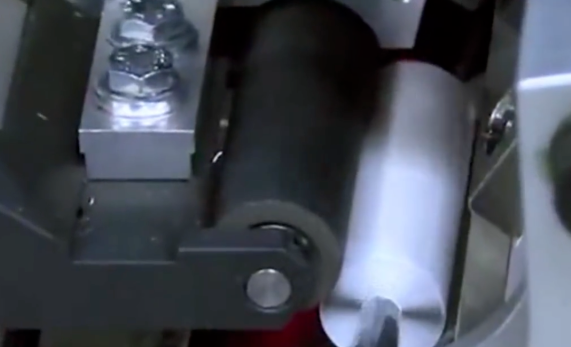
2. Laminating machine
Previous : Lithium battery industry chain the strongest interpretation!
Next : Square lithium battery insulation low problem analysis and preventive measures!


