
Dichloromethane is an organic compound with the chemical formula CH₂Cl₂. It is a clear, colorless liquid with a pungent odor similar to ether. Slightly soluble in water, soluble in ethanol and ether, under the usual conditions of use is a non-combustible, low boiling point solvent, its vapor in high temperature air becomes a high concentration will generate weak combustion gas mixture. Dichloromethane is often used in place of flammable petroleum ether, ether, etc.
Dichloromethane is a kind of organic solvent people love to hate, "love it" because it is safe to use, low price; "Hate it" because it is a carcinogen published by the World Health Organization and the International Agency for Research on Cancer, listed in the Group 2A list of carcinogens. At the same time, because it is a chlorine-containing halogenated hydrocarbon compound, can not be treated by RTO/RCO combustion and destruction, the process of environmental protection is very difficult, so in the above "National Advanced Pollution Prevention Technology Directory", the process technology of compression condensation + gas separation membrane is also used as the promotion technology of dichloromethane waste gas recovery.
In the process of compression condensation and gas separation membrane, compression and gas separation membrane are two common chemical processes. But it is not common to use compression and gas separation membranes in waste gas treatment processes. Safety experts in pharmaceutical companies are especially afraid of compression processes, so today we will talk about compression processes.
Compressors are widely used to compress and transport gas in chemical production process. Representative of ethylene production in the three compressors, namely cracking gas compressor, propylene compressor and ethylene compressor; There are also five types of compressors in the fertilizer production plant, namely air compressors, feedstock gas compressors, syngas compressors, ammonia compressors and carbon dioxide compressors. Compressor is a mechanical device used to transport gas. It converts the mechanical energy of a motor into the kinetic energy and pressure energy of the gas.
Liquid jet screw compressors are used to compress gases in a variety of processes, including chemically inert gases such as carbon dioxide and nitrogen, light gases such as hydrogen and helium, and chemically active gases such as hydrogen chloride, chlorine gas, chloromethane, dichloromethane, n-hexane, tetrahydrofuran, acetone, and MTBE. The working pressure of the liquid jet screw compressor is determined by the gas compression process. The unipolar pressure ratio can be up to 10, and the highest exhaust pressure can be up to 3MPa. The liquid jet screw compressor can be used in a single machine or in linkage with multiple units, and the exhaust gas range can be from 30m³/h to 10000m³/h.
In addition, we should also be clear that the vacuum pump is essentially a compressor, but its inlet pressure is low and outlet pressure is normal; If the inlet of the compressor is connected to the equipment to extract the gas, and the outlet of the compressor is connected to the tank, the compressor plays the role of a vacuum pump. We know that the sodium (vacuum) pump is also called liquid ring compressor, its minimum pressure can reach 4Kpa (absolute pressure).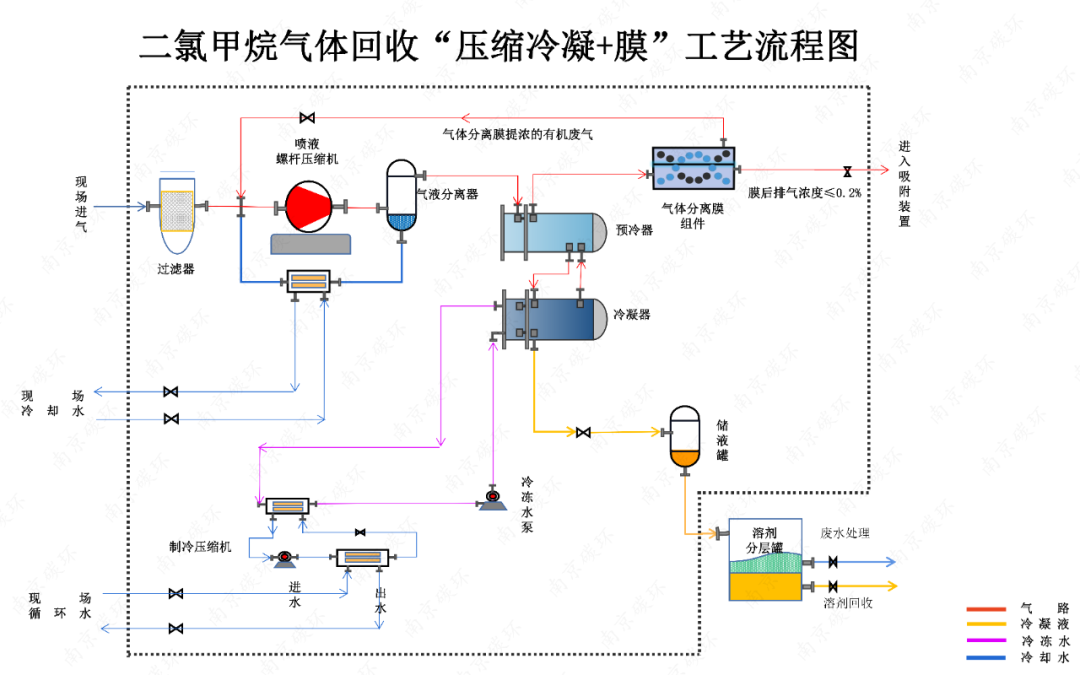
Figure 3 is a typical process flow chart of dichloromethane waste gas recovery. The dichloromethane waste gas from the production process, with a concentration of more than 10%, enters the compression condensation + gas separation film process. The intake filter removes dust and other solid impurities that may be contained in the waste gas. The spray screw compressor compresses the waste gas to 0.8Mpa, condenses it through the post-heat exchanger, liquefies the waste gas and then recovers it.
The non-condensing gas of dichloromethane in waste gas was concentrated by the gas separation membrane assembly, and then returned to the front end of the spray screw compressor for secondary compression and condensation to improve the solvent recovery efficiency of dichloromethane. The concentration of dichloromethane gas in the residual gas flowing through the gas separation membrane assembly in a cross-flow mode has been reduced from 10% of the compressor inlet to 0.2% (2000ppm), and this part of the low concentration of waste gas can be sent to the subsequent adsorption device for standard treatment. The liquid jet screw compressor is the key equipment of the process. It not only improves the condensing efficiency by more than 8 times, but also provides the pressure difference for the gas separation film, that is, the power required for the separation process.
During the compression process of the liquid jet screw compressor, compression heat is generated. The heat is absorbed by the cooling circulation liquid injected into the screw compressor and taken away. The output gas temperature of the compressor is kept below 55℃. The ignition point of dichloromethane is 662℃, and it does not occur oxidation or cracking even when heated to 290℃ with oxygen under dry condition. Therefore, 55℃ is the safe compressed gas temperature for dichloromethane exhaust gas. Doubts and concerns about the safety of dichloromethane compression are unnecessary.
The solubility of dichloromethane in water is greater than that of other chlorides. At 20℃, the solubility in water is about 2%. At 25℃, the solubility in water is about 1.7%. With the increase of temperature, the solubility gradually decreases, and a stable solubility percentage is maintained in the compressor cooling circulation fluid.
The compression and condensation recovery process of dichloromethane volatile gas has been widely used in the production of chemical synthesis drugs, new materials and lithium battery industry, realizing the source recovery and resource utilization of dichloromethane organic waste gas, and achieving the emission standard.
Contact us :
MOB/Whatsapp: +86-13505467767
E-mail: vanessa@sddslchem.com
jinhaova@gmail.com


