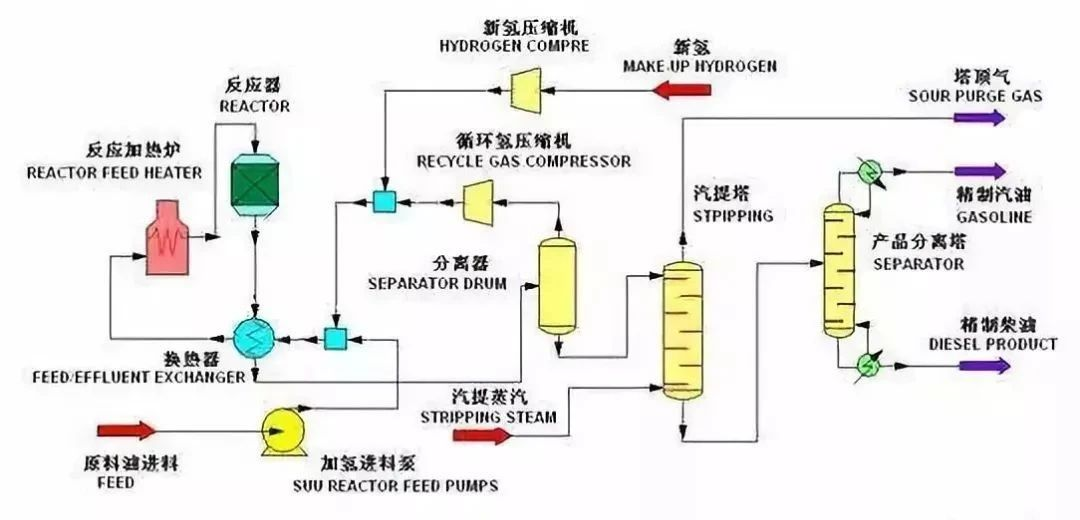
The basic approach from crude oil to petroleum products is generally as follows:
① First, crude oil is divided into different straight-run fractions according to the boiling point requirements of different products, and then the non-ideal components in these fractions are removed in accordance with the quality standards of the products;
② Through chemical reaction conversion, the required components are generated, and then a series of qualified petroleum products are obtained.
Commonly used technological processes in petroleum refining and chemical industry include atmospheric and vacuum distillation, catalytic cracking, delayed coking, hydrocracking, solvent deasphalting, hydrofining, and catalytic reforming.
Atmospheric and vacuum distillation
- Raw materials: Crude oil, etc.
- Products: Naphtha, crude diesel oil (gas oil), residual oil, asphalt, and vacuum side cut 1.
- Basic concepts
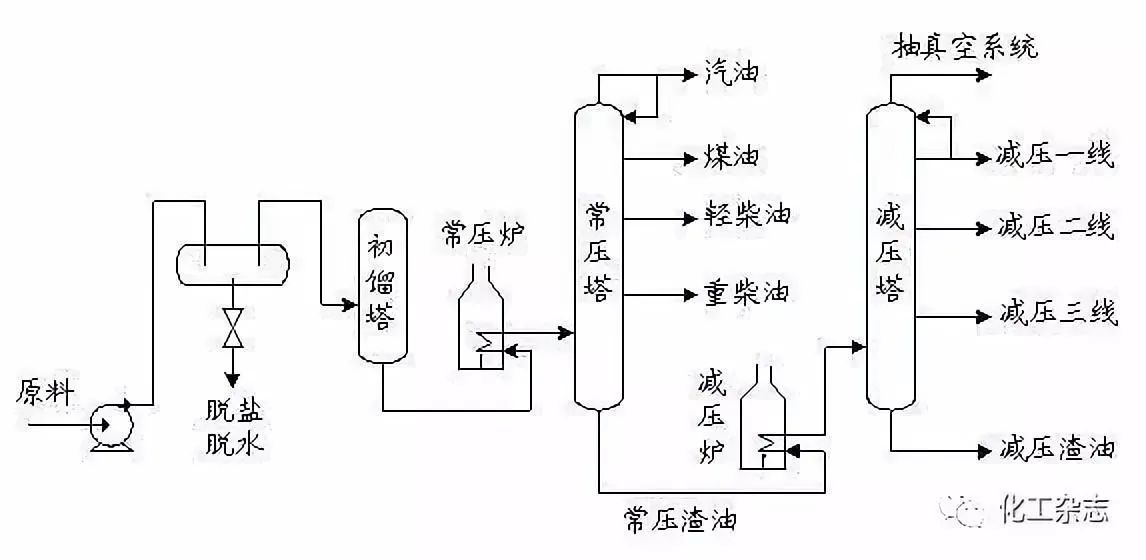
Atmospheric and vacuum distillation is the combination of atmospheric distillation and vacuum distillation, which is basically a physical process: the feedstock oil is separated into oils with different boiling point ranges (called fractions) in the distillation tower according to their evaporation capacity. Some of these oils are dispatched as products after blending and adding additives, and a large part of them serve as raw materials for subsequent processing units.
Atmospheric and vacuum distillation is the first process in petroleum processing in a refinery, known as the primary processing of crude oil, which includes three procedures: a. Desalination and dehydration of crude oil; b. Atmospheric distillation; c. Vacuum distillation.
- Production process
Crude oil usually contains salts and water, which can cause corrosion of equipment. Therefore, crude oil is first subjected to desalination and dehydration pretreatment before entering the atmospheric and vacuum distillation unit, and demulsifiers and water are usually added.
Crude oil is divided into two parts through the flowmeter, heat exchange section, and distillation tower. One part becomes overhead oil, which passes through the cooler and flowmeter and finally enters the tank farm; this part is chemical light oil (the so-called naphtha). The other part becomes bottom oil, which then goes through the heat exchange section, enters the atmospheric furnace and atmospheric tower, and is split into three parts: diesel oil, gas oil, and tower bottom oil. The remaining tower bottom oil is further processed in the vacuum furnace and vacuum tower to produce vacuum side cut 1, gas oil, residual oil, and asphalt.
Respective yields: Naphtha (light gasoline or chemical light oil) accounts for about 1%, diesel oil about 20%, gas oil about 30%, residual oil and asphalt about 42%, and vacuum side cut 1 about 5%.
The atmospheric and vacuum distillation process does not produce gasoline products. Among them, gas oil and residual oil enter the catalytic cracking process to produce finished oils such as gasoline, diesel oil, and kerosene; naphtha is directly sold to other small enterprises for producing solvent oil or enters the next step of deep processing, usually catalytic reforming to produce solvent oil or extract aromatic compounds; vacuum side cut 1 can be directly used for blending lubricating oil.
Catalytic Cracking
Generally, after atmospheric and vacuum distillation of crude oil, the light oil products such as gasoline, kerosene and diesel oil account for only 10-40%, and the rest are heavy distillates and residual oils. If more light oil products are to be obtained, secondary processing of heavy distillates and residual oils is necessary. Catalytic cracking is the most commonly used process for producing gasoline and diesel oil, and gasoline and diesel oil are mainly produced through this process. It is also the most important production link in general petroleum refining and chemical enterprises.
-
Raw materials: Residual oil and wax oil account for about 70%. Catalytic cracking generally uses vacuum distillates and coker gas oils as raw materials. However, with the increasing heaviness of crude oil and the growing demand for light oil, most petroleum refining and chemical enterprises have begun to mix vacuum residual oil into the raw materials, and even directly use atmospheric residual oil as raw materials for refining.
-
Products: Gasoline, diesel oil, slurry oil (heavy distillate oil), liquid propylene, and liquefied petroleum gas (LPG). Their respective proportions are as follows: gasoline accounts for 42%, diesel oil 21.5%, propylene 5.8%, LPG 8%, and slurry oil 12%.
-
Basic concept: Catalytic cracking is the main process for processing heavy oil (such as residual oil) into light oil (gasoline, kerosene, diesel oil) in the presence of a catalyst. It is the main secondary processing method in the oil refining process and belongs to the chemical processing process.
-
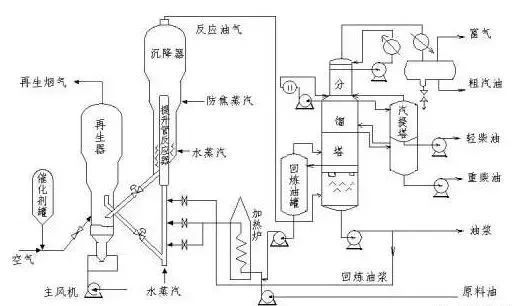
Production process: Atmospheric residual oil and wax oil enter the riser, settler, and regenerator through the feed oil buffer tank to form oil and gas, which then enter the fractionating tower.
- Part of the oil and gas enters the crude gasoline tower, absorption tower, and air compressor, then flows into the condensate tank, and after passing through the reabsorption tower and stabilizer, finally undergoes gasoline refining to produce gasoline.
- Part of the oil and gas enters the diesel stripping tower through the fractionating tower, and then undergoes diesel refining to produce diesel oil.
- Part of the oil and gas enters the slurry oil circulation through the fractionating tower, and finally produces slurry oil.
- Part of the oil and gas enters the liquid hydrocarbon buffer tank through the fractionating tower, and after passing through the desulfurization adsorption tank, sand filter tower, water washing tank, mercaptan removal extraction tower, pre-alkali washing tank, amine liquid recoverer, desulfurization extraction tower, and buffer tower, finally enters the liquid hydrocarbon tank to form LPG.
- Part of the oil and gas enters the depropanizer, reflux tower, deethanizer, propylene rectification tower, and reflux tank through the liquid hydrocarbon buffer tank, and finally enters the spherical tank in the propylene area to form liquid propylene. The liquid propylene is further processed in the polypropylene workshop to produce polypropylene.
Delayed Coking
Coking (referred to as coking for short) is a deep thermal cracking process and one of the means to process residual oil. It is also the only process that can produce petroleum coke, which cannot be replaced by any other process. Especially due to the special demand for high-quality petroleum coke in some industries, the coking process has always occupied an important position in the petroleum refining industry.
-
Raw materials: Similar to catalytic cracking, delayed coking is a decarburization process to change the carbon-hydrogen ratio of petroleum. The raw materials for delayed coking can be heavy oil, residual oil, or even asphalt, with relatively low requirements on the quality of raw materials. The main conversion processes for residual oil are delayed coking and hydrocracking.
-
Products: The main products are wax oil, diesel oil, coke, crude gasoline, and some gases. Their respective proportions are as follows: wax oil accounts for 23-33%, diesel oil 22-29%, coke 15-25%, crude gasoline 8-16%, gas 7-10%, and externally discharged oil 1-3%.
-
Basic concept: Coking uses hydrogen-poor heavy residual oil (such as vacuum residue, cracked residue, and asphalt) as raw material to carry out deep thermal cracking reactions at high temperatures (400-500℃). Through the cracking reaction, part of the residual oil is converted into gaseous hydrocarbons and light oil products; through the condensation reaction, another part of the residual oil is converted into coke. On the one hand, because the raw material is heavy and contains a considerable amount of aromatics, and on the other hand, the reaction conditions of coking are more harsh, the condensation reaction accounts for a large proportion, resulting in more coke production.
-
Production process: The production process of the delayed coking unit is divided into two parts: coking and decoking. Coking is a continuous operation, while decoking is an intermittent operation. Since industrial units are generally equipped with two or four coke drums, the entire production process remains continuous. Crude oil is preheated: the coking raw material (vacuum residue) first enters the raw material buffer tank, and then is pumped into the convection section of the heating furnace to be heated to about 340-350℃. The preheated crude oil enters the bottom of the fractionating tower and exchanges heat with the oil and gas produced by the coke drum in the fractionating tower (the bottom temperature of the tower does not exceed 400℃). The raw material oil and circulating oil are pumped out from the bottom of the fractionating tower together, sent into the radiation section of the heating furnace by a hot oil pump, heated to the temperature required for the coking reaction (about 500℃), and then enter the coke drum from the lower part through a four-way valve to carry out the coking reaction. The raw material reacts in the coke drum to form coke, which accumulates in the coke drum. The oil and gas come out from the top of the coke drum and enter the fractionating tower. After exchanging heat with the raw material oil, they are fractionated to obtain gas, gasoline, diesel oil, and wax oil. The bottom circulating oil and raw material undergo the coking reaction again.
Hydrocracking
-
The basic principle of heavy oil lightening is to change the relative molecular mass and hydrogen-carbon ratio of oil products, and these two changes usually occur simultaneously. There are two ways to change the hydrogen-carbon ratio of oil products: one is decarburization, and the other is hydrogenation.
- Raw materials: Heavy oil, etc.
- Products: Light oil (gasoline, kerosene, diesel oil, or raw materials for catalytic cracking and olefin production through cracking)
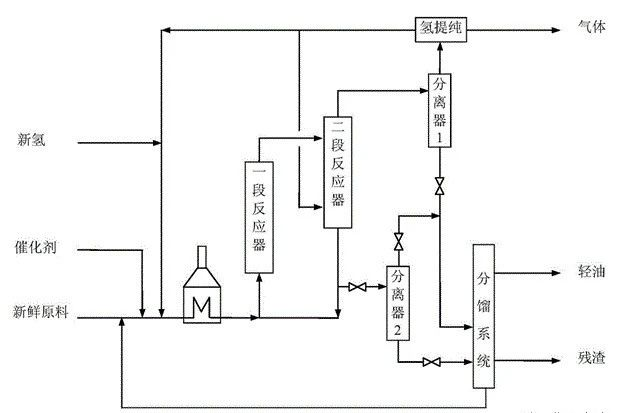
- Basic concept: Hydrocracking belongs to the hydrogenation route in the petroleum processing process. It involves supplementing hydrogen from the outside in the presence of a catalyst to increase the hydrogen-carbon ratio of oil products. In essence, hydrocracking is an organic combination of hydrogenation and catalytic cracking processes. On the one hand, it can convert heavy oil products into light oil products such as gasoline, kerosene, and diesel oil through cracking reactions; on the other hand, it can prevent the formation of a large amount of coke like catalytic cracking. Moreover, it can remove impurity compounds such as sulfur, chlorine, and oxygen in the raw materials through hydrogenation and saturate olefins.
- Production process: According to the state of the catalyst in the reactor, it can be divided into fixed bed, ebullated bed, and suspended bed (slurry bed) types.
(1) Fixed bed hydrocracking: The fixed bed refers to placing granular catalysts in the reactor to form a static catalyst bed. After the feed oil and hydrogen are heated and pressurized to meet the reaction conditions, they enter the reaction system. First, hydrofining is carried out to remove sulfur, nitrogen, oxygen impurities, and diolefins, and then hydrocracking reaction is performed. After the reaction products are cooled, separated, depressurized, and fractionated, the target products are sent out of the unit, and the gas with high hydrogen content (80%, 90%) is separated for use as recycled hydrogen. The unconverted oil (called tail oil) can be partially recycled, fully recycled, or passed through without recycling.
(2) Ebullated bed (also known as expanded bed) hydrocracking: The ebullated bed process uses the fluid flow rate to drive catalysts with a certain particle size to move, forming a gas-liquid-solid three-phase bed, so that hydrogen, feed oil, and catalysts are in full contact to complete the hydrogenation reaction process. The ebullated bed process can handle raw materials with high metal content and carbon residue (such as vacuum residue) and can achieve deep conversion of heavy oil; however, the reaction temperature is relatively high, generally in the range of 400~450℃. This process is relatively complex and has not been industrialized in China.
(3) Suspended bed (slurry bed) hydrogenation process: The suspended bed process is a hydrogenation process that has regained attention to adapt to very poor-quality raw materials. Its principle is similar to that of the ebullated bed. Its basic 流程 is to pre-mix fine powder catalysts with raw materials, then enter the reactor together with hydrogen and flow from bottom to top. The catalysts are suspended in the liquid phase for hydrocracking reactions, and the catalysts flow out from the top of the reactor together with the reaction products. This unit can process various heavy crude oils and residual oils of ordinary crude oils, but the unit investment is large. At present, this process is still in the research and development stage in China.
Solvent Deasphalting
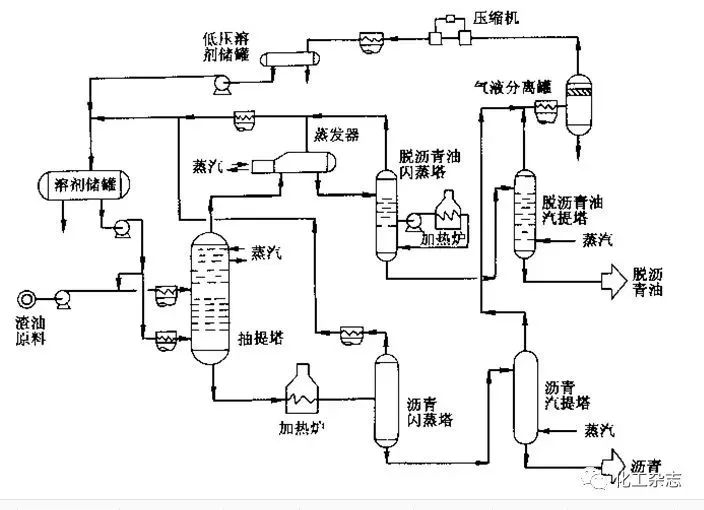
Solvent deasphalting is a pretreatment process for inferior residual oil. It is a petroleum product refining process that uses extraction to remove gums and asphaltenes from vacuum residue (and sometimes atmospheric residue) obtained from crude oil distillation to produce deasphalted oil while generating petroleum asphalt.
- Raw materials: Heavy oils such as vacuum residue or atmospheric residue.
- Products: Deasphalted oil, etc.
- Basic concept: Solvent deasphalting is a petroleum refining process for processing heavy oils. In this process, heavy oils like vacuum residue are used as raw materials, and hydrocarbons such as propane and butane are used as solvents for extraction. The extract, i.e., deasphalted oil, can be used as a raw material for heavy lubricating oils or cracking feedstock, while the extraction residue, deoiled asphalt, can be used as road asphalt or for other purposes.
- Production process: It includes extraction and solvent recovery. The extraction part generally adopts a one-stage extraction process, and can also use a two-stage extraction process. The solution of asphalt and heavy deasphalted oil contains little propane, so propane is recovered by one-time evaporation and stripping. The solution of light deasphalted oil contains more propane, so multi-effect evaporation and stripping or critical recovery and stripping are used to recover propane to reduce energy consumption. The critical recovery process utilizes the properties of propane that, under conditions close to the critical temperature and slightly higher than the critical pressure (propane's critical temperature is 96.8℃ and critical pressure is 4.2MPa), its solubility in oil is close to the minimum and its density is also close to the minimum. This allows light deasphalted oil and most of the propane to settle and separate in the critical tower, thus avoiding the evaporation and condensation process of propane and significantly reducing energy consumption.
Domestic solvent deasphalting processes mainly include sedimentation two-stage deasphalting process, critical recovery deasphalting process, and supercritical extraction solvent deasphalting process.
(1) Sedimentation two-stage deasphalting process: The sedimentation two-stage deasphalting process is developed on the basis of the conventional one-stage deasphalting. Based on the study of the unique properties of Daqing vacuum residue, it was noted that conventional propane deasphalting could not fully utilize this resource, thus a new deasphalting process was developed.
(2) Critical recovery deasphalting process: The solubility of the solvent in oil decreases with the increase of temperature. When the temperature and pressure are close to the critical conditions, the solubility of the solvent in oil has dropped very low. At this time, the propane solvent can be directly recycled after cooling without evaporation recovery.
(3) Supercritical extraction solvent deasphalting process: Supercritical fluid extraction is a technology that utilizes the abnormal phase equilibrium characteristics and unusual thermodynamic properties of the extraction system near the critical region. By changing parameters such as temperature and pressure, the mutual solubility between components in the system changes drastically, thereby achieving component separation.
Hydrofining