


The overseas market was informed that on December 6, local time, Coxtronic Germany's Uerdingen plant was seriously damaged due to electrolytic cathode lines. Therefore, the plant and downstream production plants, such as MDI and PCS plants, had to stop operation.
At this point, Cosco cannot predict exactly how long the situation will last or when production will resume. Based on Coxtron's current assessment, it is expected that only a small degree of repair will be possible in the affected electrolysis lines. As a result, there will be a big shortfall in the delivery of the products concerned.
In addition, Cosco indicated that in a best-case scenario, the chlorine plant would be fully restarted by December 31, 2022. The Company will keep customers updated on the assessment, especially regarding the restart date.
As a result of this incident, Coxtron declares force majeure will affect the following products:
- Chlorine gas
- Sodium hydroxide solution
- Hydrochloric acid
- Hydrogen gas
- Polycarbonate products
- Certain MDI products
Cosco also said it will keep customers updated on developments and any steps it is taking to prevent or minimize disruption and loss to customers.
It is worth mentioning that Coxtron has suffered a number of force majeure events this year.
In mid-August, Coxtron's 300,000 TDI plant in Germany experienced force majeure due to a chlorine gas leak.
On March 31, a force majeure event occurred in the supply of polycarbonate (PC) at Cosco's Baytown, Texas plant.
On February 8th, due to unforeseeable emergencies in the hydrochloric acid logistics in Leverkusen, Cosco HDI and IPDI production was affected, and immediately declared force majeure on the supply of HDI and IPDI.
Among the products affected by the force majeure, Cosco has the world's largest production capacity in one product, polycarbonate, or PC.
polycarbonate (PC for short) is a thermoplastic engineering plastic with excellent comprehensive properties. As a material with the fastest growing consumption among the five general engineering plastics, polycarbonate has good mechanical properties, optical properties, thermal properties and flame retardant properties. It is widely used in automobile parts, consumer electronics, electrical engineering, household appliances, light-emitting diodes (LED), building boards, consumer durables, optical lenses, optical disc base materials, special protection and medical equipment and many other fields.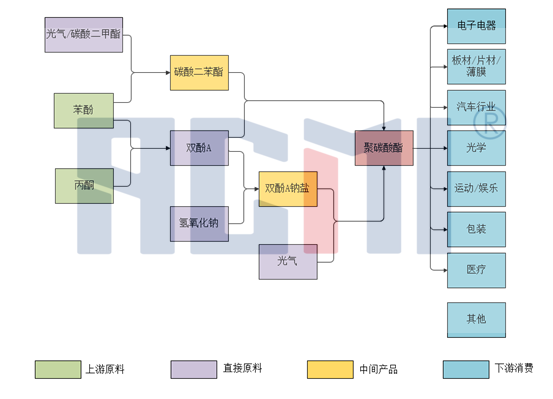
By the end of 2022, global polycarbonate production capacity has exceeded 7.5 million tons/year, with production facilities mainly located in Northeast Asia, Western Europe and North America. In 2022, the combined production capacity of polycarbonate in the above three regions is close to 90% of the global total, among which Northeast Asia has the highest concentration of polycarbonate production, mainly distributed in mainland China, South Korea, Japan and Taiwan. In addition, in recent years, the increase of global polycarbonate production capacity is concentrated in Northeast Asia, and China is the main growth.
In the production of polycarbonate, the global supply of oligopoly pattern. Among them, Coxtron ranks first in the world with an annual production capacity of over 1.6 million tons. Shabik is the second largest in the world with a production capacity of nearly 1.5 million tons per year; Zhejiang petrochemical industry ranks the third. Taken together, the top three PC makers account for nearly half of the world's total capacity.
In recent years, China's polycarbonate industry has witnessed rapid development, with the production capacity increasing from nearly 1.2 million tons/year in 2018 to nearly 3.2 million tons/year in 2022, with an annual compound growth rate of nearly 28%. Production increased from nearly 750,000 tons in 2018 to nearly 1.7 million tons in 2022, a compound annual growth rate of nearly 25 percent. Generally speaking, the growth rate of polycarbonate production is not as fast as that of production capacity, which also makes the industry operating rate tend to decline.
