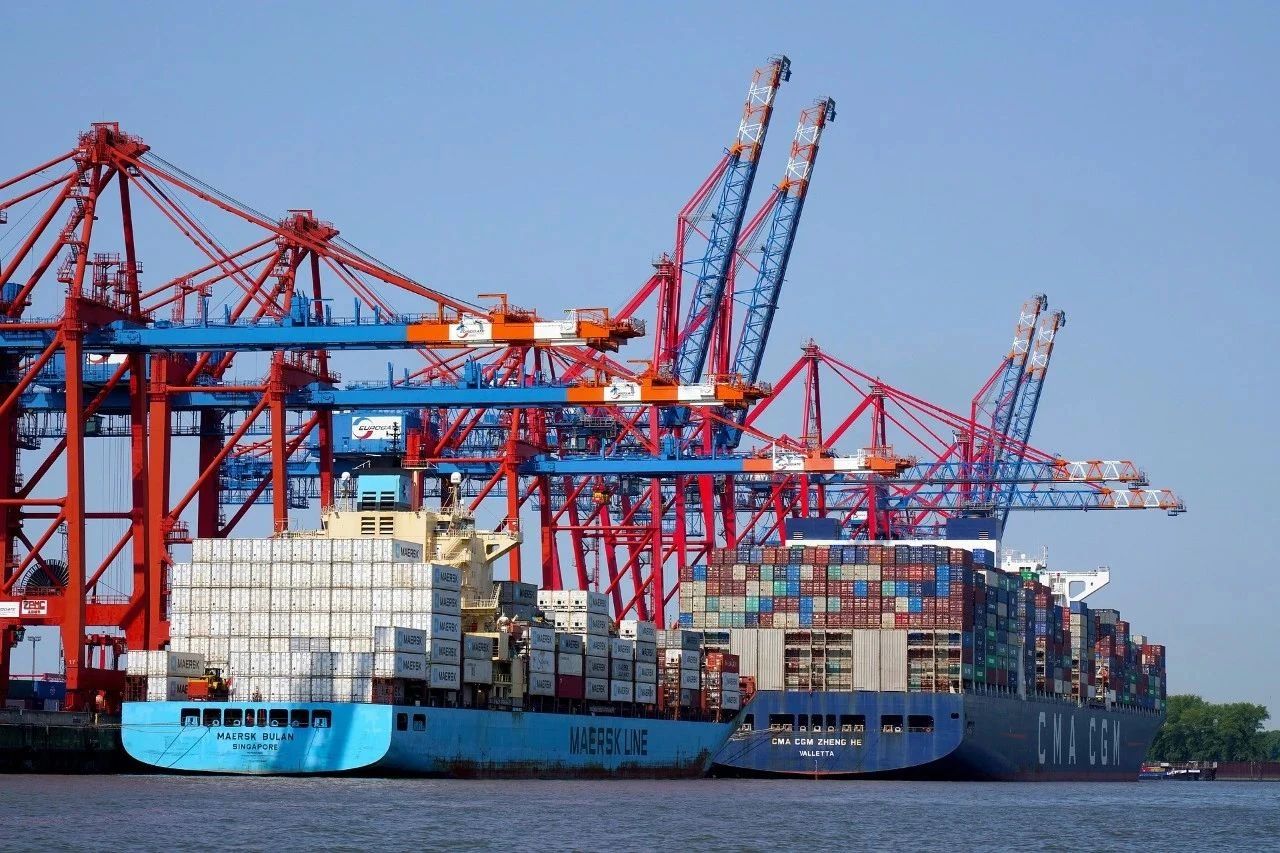
 In the context of the escalating crisis in the Red Sea and high demand, global capacity continues to be tight, and multi-route freight rates have risen sharply. Lack of space and lack of cabinets increase the pressure on enterprises. Now, not only the shortage of ships, container supply is tight, even the port is not busy...
Shanghai Port faces its biggest challenge in three years
According to a recent report released by Bank of America, since March this year, the global port congestion has significantly increased, which has directly caused the supply of container ships to decrease by more than 2%. Currently, Singapore, Dubai and the Mediterranean region have become the main focus of congestion problems, while the supply of seats in Asia continues to be tight.
According to a recent report by Linerlytica, an Asian container consultancy, container ships at the Port of Singapore, the world's second-largest container port, may now have to wait up to seven days for a berth, compared with a normal half day. This poses great challenges for the global shipping industry.
The latest figures show a surge in the number of containers waiting to be docked in Singapore in May, with a peak of 486,600 20-foot standard containers in late May. That number far exceeds the all-time high reached during the coronavirus outbreak.
Port congestion is particularly severe in Asia, where Southeast Asian ports account for 26% of global port bottlenecks, while Northeast Asian ports account for 23%. This shows that port transportation in the Asian region is facing a huge challenge.
To ease congestion, PSA Singapore has reactivated the old berths and storage yards at the defunct Keppel Terminal, while also adding significant manpower to deal with container build-up.
In addition to hot spots such as Singapore and the Mediterranean, many Asian ports such as Shanghai, Qingdao, Port Klang and Colombo also experienced varying degrees of congestion. It is worth noting that as the world's largest container port, the stay time at Shanghai Port has reached the highest level in nearly three years!
In addition, Mediterranean Shipping (MSC), the world's largest container liner, began to use India's Kamalagal and Vishahapatnam ports for transshipment operations.
A shipping company executive said that rather than having ships wait a week to 10 days at the port of Singapore, some shipping companies prefer to drop off containers at Indian ports. However, Indian ports will also be congested because the current terminal yard utilization rate is already high.
Maersk grounded
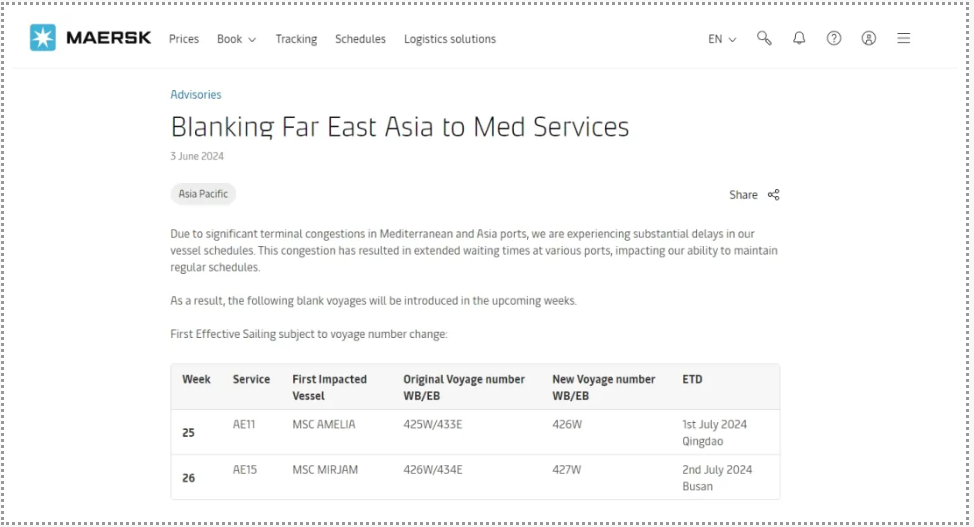
In this regard, shipping giant Maersk issued an announcement on June 3, saying that due to the serious congestion problems faced by major ports in the Mediterranean and Asia, its shipping schedule has suffered serious delays. This congestion has resulted in significantly longer waiting times at ports, affecting Maersk's ability to maintain normal shipping schedules.
In response to the current port conditions, Maersk plans to launch two blank voyages in the coming weeks, with the following specific suspension plans:
AE11: Cancellation of voyage 425W by MSC AMELIA from Qingdao to Valencia on 1 July 2024;
AE15: Cancellation of Voyage 426W by MSC MIRJAM from Busan to Tekilda on 2 July 2024.
In addition, on Friday (May 31), Maersk also issued an announcement announcing the closure of the Asia-United States East TP20 route. The following is specific information about the last voyage of the TP20 route:
Last Voyage from Asia: Voyage 424E BSG Barbados ETD Shanghai13 June 2024
Last Voyage from North America: Voyage 429W BSG Barbados ETD Newark17 July 2024
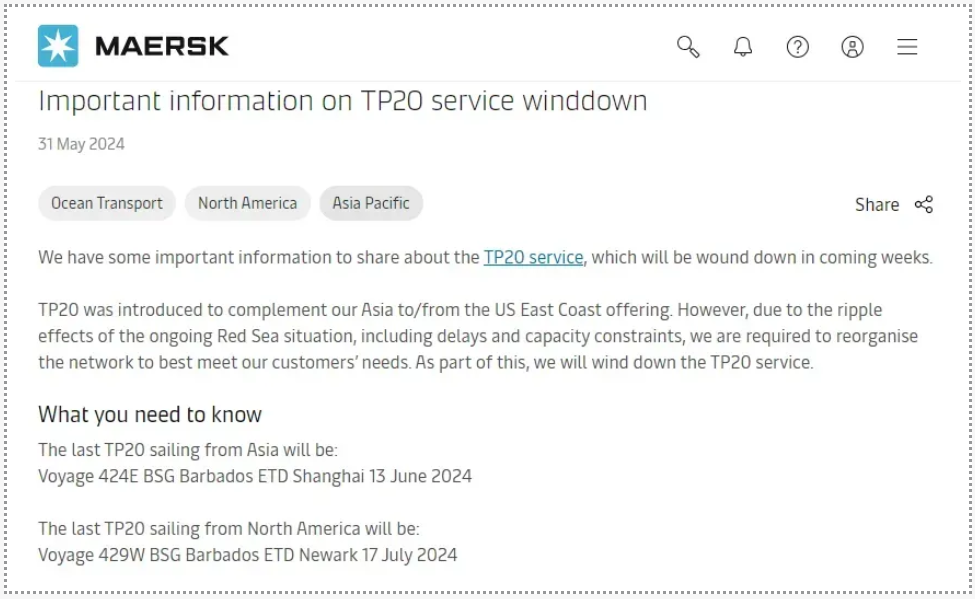
As for the closure of TP20 routes, Maersk gave an official explanation: "Due to the knock-on effects of the current situation in the Red Sea, including delays and capacity constraints, we need to restructure our network to best meet the needs of our customers." As part of this, we will phase out the TP20 route."
No price cut in sight
Meanwhile, the latest edition of Drewry's data shows that of the 661 scheduled voyages on major routes such as Trans-Pacific, Trans-Atlantic and Asia-Nordic and Mediterranean routes, 43 voyages have been announced for the period 23 weeks (June 6 - June 9) to 27 weeks (July 1 - July 7), representing a 7% cancellation rate.
About 54 per cent of the cancelled flights will be on trans-Pacific eastbound routes, 30 per cent on Asia-Nordic and Mediterranean routes and 16 per cent on trans-Atlantic westbound routes.
Specific to the suspension arrangement in the next five weeks, the three major alliances cancelled a total of 43 routes, of which:
Ocean Alliance: cancellation of 11 voyages;
THE Alliance: cancellation of 7 voyages;
2M Alliance: cancellation of 8 voyages;
Non-affiliate companies: cancellation of 17 voyages.
Drury said that while the increase in ship speed and the increase in transshipment volume has helped maintain the frequency of container traffic turnover, the increase in port congestion is further affecting the container market.
Singapore's status as Asia's worst affected port by congestion has forced some shipping companies to cancel calls at the port, with the potential impact of increased cargo volumes and further delays at downstream ports.
This concentration of congestion can lead to overflow congestion at other regional ports and disruption to transportation plans. Continued congestion is likely to facilitate the implementation of the GRI announced by shipping companies and could further drive up freight rates.
As of May 30, Asia-to-Europe freight rates are now $6,200 per 40-foot container, while Asia-to-North America West Coast freight rates have climbed to $6,100.
The Red Sea crisis is believed to be the "culprit" of the current round of traffic jams. If the situation in the Red Sea does not improve, this bad situation may continue for some time. And because congestion is difficult to ease, freight rates will continue to be pushed up.
The latest Shanghai Freight Index (SCFI) released by the Shanghai Shipping Exchange on May 31 was 3044.77 points, up 12.63% from the previous period.

