
Supply, demand and logistics of sulfur market in Shandong province
Sulfur products are by-products of natural gas processing, oil refining and coal chemical industry, and the output is determined by the sulfur content of raw materials, so the market supply is unstable. Easy to solidify, the temperature in the pipeline and storage tank needs to be maintained at 120-145 ° C, the transport needs a special tank car (ship), the transport radius is maintained within 450 kilometers, once solidified, more difficult to deal with; Sulfur products are easily explosive dangerous goods and need to be recorded in the public security system.
Supply: At present, the total domestic sulfur production capacity is about 15.3 million tons, of which the total production capacity of Shandong is about 1.94 million tons/year, accounting for 12.6% of the total national production capacity, and the output is about 1.1 million tons, accounting for about 10.6% of the total national production. Sulfur in Shandong is divided into solid and liquid forms, of which liquid is the main source, accounting for more than 80%, the main source is Sinopec and local refining, and a small amount comes from coal chemical desulfurization; Sinopec accounted for about 40%, local refining accounted for about 57%, coal chemical accounted for about 3%.
Demand: There are many kinds of downstream consumption in Shandong, widely distributed and scattered, mainly caprolactam, sulfuric acid, titanium dioxide, carbon disulfide, methionine, citric acid and so on. By the end of 2023, the downstream consumption in Shandong has reached 1.9 million tons/year, accounting for about 10% of the total downstream consumption in China. Due to the shortage of local sulfur production, there is a gap of 800,000-900,000 tons per year that needs to be supplied by external sources, which are mainly imported from Japan and South Korea and Hebei, Tianjin, Jiangsu and other places.
Logistics: Domestic sulfur transport is mainly divided into automobile transport, water transport and rail transport, Shandong Province in the automobile transport, the port is the Japanese, Korean liquid sulfur resources by water transport, arrived in Weifang port or Longkou port, and then sent to the terminal factory by automobile transport.
The main factors affecting Shandong sulfur market
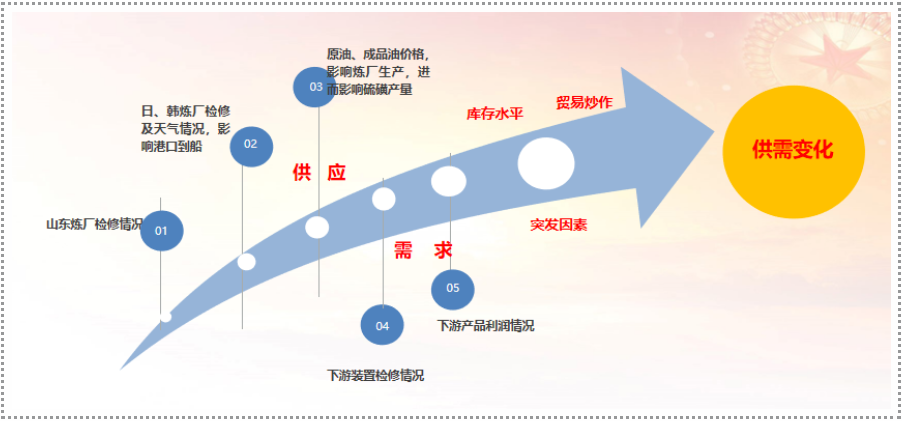
The sulfur market in Shandong province fluctuates mainly due to changes in supply and demand. Its supply is mainly by refinery start-up + import, refinery start-up is affected by crude oil prices, refined oil profits, maintenance and other factors, imports are affected by Japan and South Korea refinery start-up, shipping, weather, geopolitics and other factors; The demand is mainly affected by downstream maintenance and industry profits, in addition to changes in port inventory, traders purchasing behavior and extreme weather, transportation control, environmental inspection and other unexpected factors, will also lead to big changes in the market.
Aftermarket analysis of Shandong sulfur market
In recent years, the supply and demand pattern of sulfur in Shandong is basically stable, but with the production of Yulong Petrochemical in the fourth quarter, the supply and demand pattern of sulfur in Shandong may change greatly. Yulong Petrochemical production is large, located in the east, limited by the transportation radius, its impact on the central and eastern areas is relatively large, then the sulfur resources in the central area of Shandong or will move west.
In addition, Shandong's sulfur resources are in short supply and rely on imports from Japan and South Korea to fill the gap, while in the past two years Japan's small refineries have been shut down more (roughly estimated to be about 200,000 tons), and due to the aging of most refinery installations, their maintenance time has also been extended, and the overall Japanese sulfur production has declined; South Korea, on the other hand, is increasing the proportion of solid resource output. In addition, the demand release in Southeast Asia will shift the supply volume originally given to China by Japan and South Korea, which will also lead to a shortage of imported sulfur in Shandong and an increase in long-term settlement costs.