Adiponitrile, also known as 1, 4-dicyanobutane, chemical formula C6H8N2, abbreviated as ADN, is a colorless transparent oily liquid, slightly bitter, slightly soluble in water, soluble in ethanol, chloroform, insoluble in ether, carbon disulfide.
Adipdinitrile is mainly used for the preparation of adipenediamine, and can also be used as a rubber accelerator and rust inhibitor, as an additive to detergents, spinning solvents, colorants for polyamides, additives for fabric bleach, and as a plasticizer for acetate, propionate, butyrate and mixed ester.
Adiponitrile is an important organic chemical intermediate, mainly used in the production of PA66, 1, 6-adiponitrile diisocyanate (HDI), PA610 and other materials.
Adiponitrile downstream demand is large, currently considering the adiponitrile project many Chinese companies, a variety of process routes have, production capacity is large and small, site selection is also different, companies need to combine their own circumstances to make relevant choices in order to ensure comprehensive competitiveness.
Adiponitrile process route analysis
At present, the synthesis process of adipdinitrile is mainly divided into butadiene, acrylonitrile and adiponic acid.
01. Butadiene method
The process is to obtain adiponitrile from butadiene by direct cyanidation.
The direct cyanation reaction is as follows:
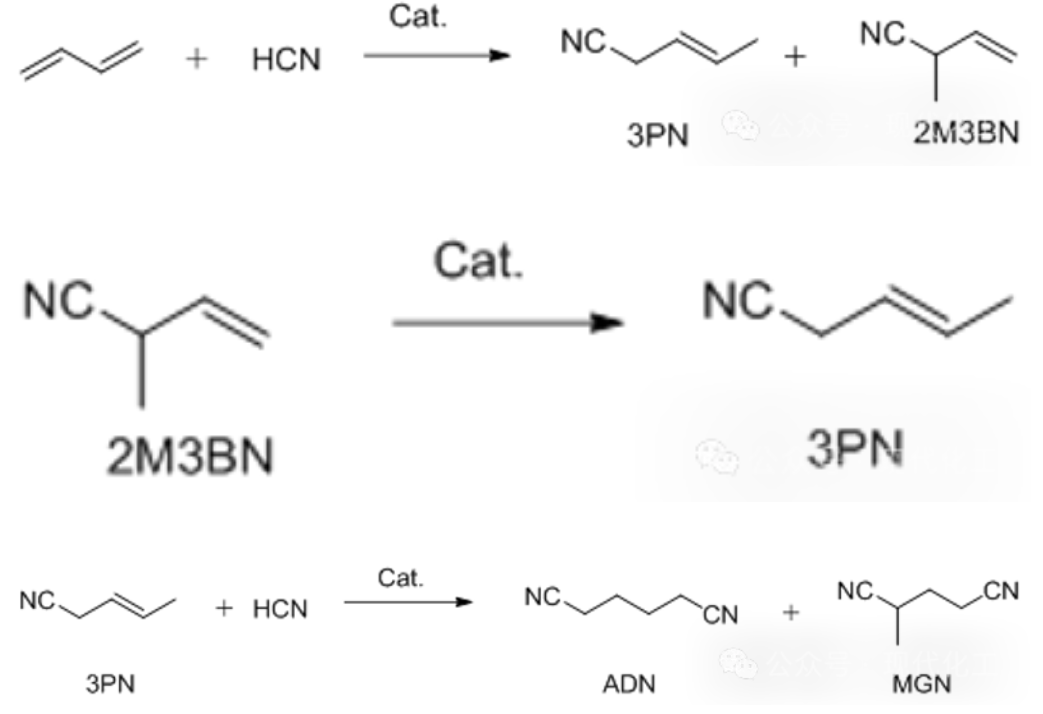
In the early 1970s, DuPont developed butadiene direct cyanide production of adiponitrile, the method of low raw material cost, low energy consumption, short process route, and good product quality, high yield, is the most ideal industrial route, suitable for large-scale industrial production. The adiponitrile produced by this process accounts for 65% to 70% of the world's total, which is the most advanced production process at present. Butadiene direct cyaniding process includes three steps: generation of pentenonitrile, isomerization reaction and separation, adiponitrile preparation: Firstly, butadiene, hydrocyanic acid, solvent and catalyst were cyanided at high temperature to obtain 3-pentenitrile and 2-methyl-3-butenitrile. Butadiene was recovered under reduced pressure and returned to the reactor for recycling. 3-pentenitrile and 2-methyl-3-butenitrile were separated by distillation. 2-methyl-3-butenonitrile is synthesized into 3-pentenitrile by isomerization. 3-pentenonitrile is cyanided again to adipic dinitrile, and the final product adipic dinitrile is produced by a refining system.
02. Acrylonitrile process
The process route uses acrylonitrile as raw material to produce adipic dinitrile by electrolytic hydrogenation dimerization. The reaction is as follows:

The acrylonitrile production process was first developed and successfully used by Monsanto in the United States in the 1960s, and later Japan's Asahi Kasei Company also mastered the technology, and Suno Company (formerly Monsanto Company) sold the technology to the United States. The production of adiponitrile by electrolytic hydrogenation dimerization was initially done by diaphragm electrolysis, and then gradually developed into non-diaphragm electrolysis. Diaphragm electrolysis method is divided into solution method and emulsion method, Monsanto Company first developed the solution method, and later Japan Asahi Kasei Company developed the emulsion method on the basis of Monsanto Company. Acrylonitrile dimerization requires high energy consumption, high investment in equipment, and large carbon dioxide emissions, there is environmental pressure. The process has many side reactions, and the electrolytic process will produce propanitrile, trimer, 2-methylglutaronitrile and other substances. In addition, the electrolysis process will inevitably produce oxygen, and there are certain hidden dangers in the safety of the process. The comprehensive production cost of adiponitrile preparation by acrylonitrile method is higher than that by butadiene method.
03. Adipic acid process
The process takes adipic acid as raw material, first ammoniated, and then dehydrated to obtain adipic dinitrile, the reaction is as follows:

This method was first developed by Rhodia Company in France, and then Monsanto Company in the United States (now renamed as Cunio Company), Radisi company in Italy and BASF company in Germany have also been successfully developed and used. China Liaoyang Petrochemical Company in the 1970s from France Rhodia company introduced a complete set of Hethylene diamine production plant. Adipic acid method is divided into liquid phase method and gas phase method. Liquid phase method is to melt adipic acid at 200 ~ 300℃, ammoniated dehydration in the presence of catalyst phosphoric acid, the reaction product through dehydration, depolymerization, chemical treatment and vacuum distillation steps to obtain pure adipic dinitrile. The quality of liquid phase method was poor, and the yield was 84% ~ 93%. The gas phase method is divided into BASF method and Monsanto method, and the product quality and yield are significantly improved compared with the liquid phase method. The disadvantage of adipic acid process is that there are more by-products and the product quality is not good, and the method is largely affected by the price of adipic acid. Due to the rise in the price of adipic acid, as well as the increasing improvement of acrylonitrile and butadiene methods, adipic acid method has no competitive advantage, Italy's Radii Company stopped production in 1996, China's Liaoyang Petrochemical Branch also stopped production in 2002, and Chongqing Huafeng Chemical Co., LTD. (self-produced adipic acid, lower cost) is using adipic acid method to produce adipic acid.
Butadiene method, acrylonitrile method and adipic acid method have their advantages and disadvantages. Butadiene method is the mainstream process for the production of adipic nitrile in the world at present, and the adipic nitrile prepared by this method accounts for about 70% of the global adipic production capacity, which is the most competitive process in terms of comprehensive competitiveness.
Product application analysis
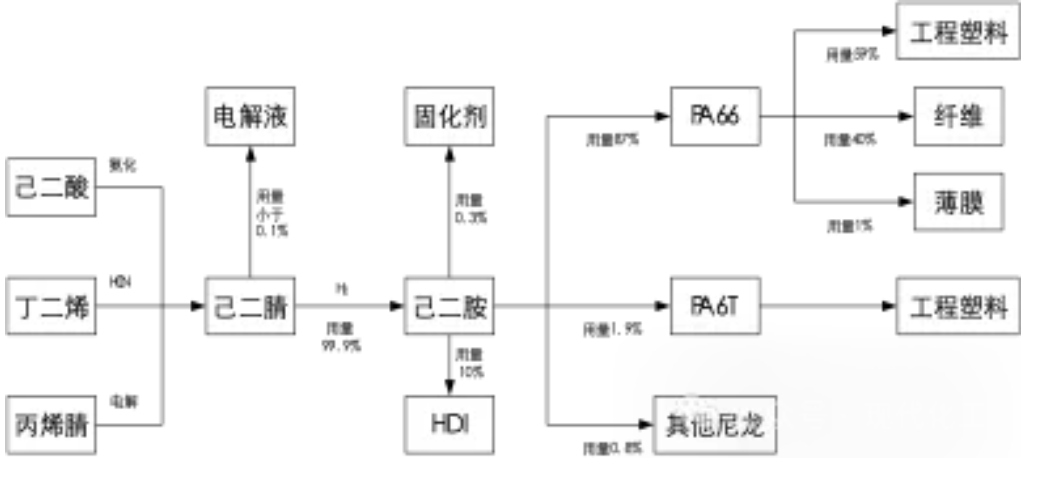
Most of the adiponitrile is used in the production of Hexamethylene diamine, and only a small amount is used in the electrolyte. Hexamethylene diamine is mainly used in PA66 and HDI, a small amount is used in PA6T and other PA, and a very small amount is used in curing agent, the specific application share is shown in the figure
Adiponitrile supply and demand situation and trend analysis
In 2022, the global demand for adiponitrile is about 1.55 million tons, of which China's demand for adiponitrile is about 380,000 tons.
Adiponitrile manufacturers in the world have basically built supporting downstream production devices, and most of the production capacity is used for the production of adiponitrile and PA66 of the company, only Invista of the United States and BASF of Germany have some remaining adiponitrile products for export.
Before 2019, China had no industrial production equipment for adiponitrile, and the required adiponitrile was all dependent on imports. In 2019, Chongqing Huafeng adiponitrile project was put into operation, and about 30,000 tons of adiponitrile will be produced in 2020. In 2017, China's adiponitrile consumption was 279,500 tons, and in 2022, China's adiponitrile consumption increased to 383,300 tons, with an average annual growth rate of more than 6%.
As of November 2023, there are six major companies in the world with adiponitrile production capacity, with a combined capacity of about 2.4 million tons/year. As the world's largest adiponitrile producer, Invista has an equity production capacity of 1.07 million tons/year, and two adiponitrile plants in Texas, USA, with a total production capacity of 810,000 tons/year. In October 2023, the Orange plant was shut down (production capacity of 516,500 tons/year). The Butachimie plant in France has a capacity of 600,000 tons/year, and Invista and BASF each have a 50% interest, so BASF also has an equity capacity of 300,000 tons/year of adiponitril, and the above plants use the butadiene method. The existing 545,000 tons/year adipdinitrile production capacity, the factory is located in Alabama, the acrylonitrile method, has been expanded many times in history, the general single expansion capacity of about 90,000 tons/year, the latest expansion completed in the second half of 2020, the expansion capacity of 90,000 tons/year. In addition to the above manufacturers, Asahi Kasei has 43,000 tons/year of acrylonitrile adipic dinitrile production capacity, before the domestic adipic dinitrile, the global production capacity has long been Invista, Alrise, BASF, Asahi Kasei four manufacturers monopoly, of which Invista, Alrise and BASF total production capacity accounted for more than 80% of the world. In 2022, Tianchen Qixiang has been tested and obtained qualified products, but there are not a large number of products on the market, there may be some problems in operation, and the production capacity has not been fully released.
In 2022, China's adiponitrile production of about 100,000 tons, the domestic market needs adiponitrile is still mainly dependent on imports, but according to statistics, Chongqing Huafeng, what Aidian, Anhui Light and many other enterprises have layout adiponitrile, while foreign companies also increase the layout of adiponitrile industry chain in China. With the successive production of adiponitrile and PA66 projects, domestic adiponitrile and PA66 production capacity ushered in a period of rapid expansion.
Industrialization difficulties and suggestions
technology
Butadiene direct cyanide method is the most advanced preparation technology in the world at present, which has significant advantages in increasing yield, reducing energy consumption, increasing process stability, product yield and quality, etc. However, industrialization is relatively difficult, especially the matching degree of equipment and process should be paid attention to. It is recommended to make good selection and verification in the selection of catalyst, engineering design, key equipment selection and material selection (reactor, filter, etc.).
Industrial chain
Adiponitrile is a link in the PA66 industry chain, most of the current adiponitrile enterprises have carried out adiponitrile -PA66 industrial integration, adiponitrile basically has no takeout market, so it is recommended to distribute downstream PA66 or HDI, or cooperate with other enterprises.
Cheap raw material
Raw materials account for 60% to 70% of the manufacturing cost of adiponitrile, if there is no cheap raw materials it is difficult to have a cost advantage, so it is recommended to cooperate with refining enterprises, and the factory is built next to refining enterprises to reduce the cost of raw materials.
scale
200,000 tons/year adipic dinitrile is about 10% lower than the cost of 50,000 tons/year scale, and the cost difference caused by scale will also have a significant impact on enterprises when competition is fierce, so it is recommended to increase production capacity as much as possible in the case of upstream and downstream matching, in order to reduce costs and enhance competitiveness.
conclusion
The main process routes of adipic acid are butadiene method, acrylonitrile method and adipic acid method. The existing production capacity accounts for 66.6%, 24.9% and 8.5% respectively. From the perspective of cost, quality and environmental protection, butadiene method is an ideal industrial production route.
Due to the increase in demand for PA66 at home and abroad, it is expected that the global demand for adiponitrile will reach about 1.85 million tons in 2027, with a CAGR (compound annual growth rate) of 3.5%, and with the layout of various companies, adiponitrile will also enter a blossoming situation.
The key elements of the industrialization of adiponitrile are mainly the selection of catalysts, engineering design, key equipment selection, industrial chain supporting, cheap raw materials, production capacity, etc., need to go through systematic planning and verification, in order to ensure that the project has comprehensive competitiveness.


