


1. Adiponitrile method
At present, all the methods for mass production of adipdinitrile are adipdinitrile. The reaction mechanism is that under the action of a certain temperature, pressure and catalyst, adiponitrile and hydrogen gas addition reaction to produce adipdiamine.
The reaction equation is as follows:

The process is divided into high pressure method and low pressure method. There are two types of high-pressure methods, depending on the catalyst. One is iron based catalyst, reaction pressure is 30 ~ 35Mpa, reaction temperature is 100 ~ 180℃. The other is cobalt-copper catalyst, which requires a high reaction pressure of 60 ~ 65Mpa and a reaction temperature of 100 ~ 135℃. The high pressure method uses three phase fluidized bed as the reactor type, liquid ammonia and toluene as solvents, and the selectivity is up to 90% ~ 95%.
The low pressure method adopts nickel-based catalyst, reaction pressure is 1.8 ~ 3.0Mpa, reaction temperature is 60 ~ 100℃. The low pressure method uses ethanol as solvent and strong alkali compound as cocatalyst to improve the activity of catalyst. 99% hexamethylenediamine can be obtained by low pressure refining.
2. Adipic acid process
The core of this method is to take adipic acid and ammonia gas as raw materials, ammonia reaction to produce ammonium adipate and water, ammonium adipate dehydration at high temperature to produce adipdinitrile, adipdinitrile reaction with hydrogen gas to produce adipdiamine.
Adipic acid method mainly includes gas phase method and liquid phase method. Compared with the gas phase method, the liquid phase method has a lower reaction temperature, less damage to the catalyst, fewer byproducts and higher yield, so the liquid phase method is mainly used for amination adipate.
3. Caprolactam method
Caprolactam was used as raw material and phosphate as catalyst. The reaction mechanism is that caprolactam reacts with ammonia gas to dehydrate to produce amino-capronitrile, which then reacts with hydrogen gas at high temperature to produce adipdiamine. The yield of caprolactam is very high. Caprolactam can be obtained from the defective nylon 6. It is an environmentally friendly process.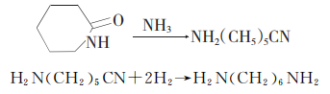
4. Hexadiol process
Using 1, 6-hexadiol as raw material and nickel as catalyst, hexamethylene amine was produced by ammoniation reaction with ammonia gas under high temperature and high pressure.
5. Butadiene method
Under a certain temperature and pressure, 1, 3-butadiene is cyanated with hydrocyanic acid to form pentylene nitrile, which in turn reacts with hydrocyanic acid to form adipdinitrile, which reacts with hydrogen gas to produce adipdinitrile. This method was developed on the basis of 1, 3-butadiene preparation of adiponitrile.
|
Chemical Name |
Abbreviation |
CAS NO. |
|
1, 4-Butanediol |
BDO |
110-63-4 |
|
1,4-Butyrolactone |
GBL |
96-48-0 |
|
Tetrahydrofuran |
THF |
109-99-9 |
|
1-Methyl-2-pyrrolidinone |
NMP |
872-50-4 |
|
Methylene Chloride |
MC |
75-09-2 |
|
Aniline oil |
Aniline |
62-53-3 |
|
Cyclohexylamine |
CHA |
108-91-8 |
|
Dimethylformamide |
DMF |
68-12-2 |
|
Dimethylacetamide |
DMAC |
127-19-5 |
|
Dicyclohexylamine |
DCHA |
101-83-7 |
|
Adipic acid |
AA |
124-04-9 |
|
Melamine |
Melamine |
108-78-1 |
|
N-Tertiarybutyl-2-benzothiazole sulfenamide |
TBBS(NS) |
95-31-8 |
|
2-Mercaptobenzothiazole |
MBT(M) |
149-30-4 |
|
N-Cylcohexyl-2-benzothiazole-sulfenamide |
CBS(CZ) |
95-33-0 |
|
Dibenzothiazole Disulfide |
MBTS(DM) |
120-78-5 |
Contact us :
MOB/Whatsapp: +86-13505467767
E-mail: vanessa@sddslchem.com
jinhaova@gmail.com
Linkedin: linkedin.com/in/vanessa-zhang-11521973
